
Enterprise AIoT Knowledge Hub for Spare Parts & MRO Logistics
Enterprise Spare Parts & MRO Logistics is responsible for ensuring that maintenance organizations always have the correct replacement components, repairable assets, consumables, and critical spares available at the right location and at the right time. Whether supporting industrial manufacturing facilities, power generation plants, mining operations, transportation fleets, utilities, aerospace maintenance organizations, or heavy equipment service centers, maintenance logistics directly influences equipment availability, maintenance productivity, and operational continuity.
Unlike conventional warehouse operations that primarily manage finished goods, Spare Parts & MRO Logistics focuses on highly dynamic inventories consisting of serialized components, rotable assets, repairable units, bench stock, maintenance kits, critical spare assemblies, contractor-managed inventory, and warranty-controlled replacement parts. These inventories often span multiple warehouses, maintenance depots, forward stocking locations (FSLs), field service vehicles, cross-dock facilities, and regional distribution centers, creating significant operational complexity.
The MRO Resources Hub from MROLog AI serves as a centralized technical knowledge repository dedicated to enterprise AI and IoT implementations within Spare Parts & MRO Logistics. The content emphasizes practical engineering guidance, implementation methodologies, deployment planning, and enterprise integration rather than high-level technology discussions. Every resource is written to help technical professionals improve inventory visibility, maintenance material flow, warehouse efficiency, and lifecycle traceability using enterprise-grade identification and location technologies.
Rather than concentrating on generic Industrial IoT topics, this knowledge center specifically addresses the operational challenges unique to maintenance logistics, including:
- Serialized spare parts identification
- Rotable component lifecycle management
- Maintenance depot inventory visibility
- Parts crib inventory control
- Critical spare availability
- Repairable asset tracking
- Bench stock management
- Core return processing
- Maintenance work order material allocation
- Multi-site warehouse synchronization
- Field service parts logistics
- Forward stocking location management
- Service parts distribution
- Contractor-managed inventory
- Enterprise maintenance supply chain coordination
Organizations deploying AI and IoT solutions for these environments require far more than basic inventory management. They need accurate identification, precise location awareness, secure access management, automated inventory reconciliation, standardized component traceability, and reliable integration with enterprise software supporting maintenance planning and warehouse operations.
Throughout this Resources Hub, the technical guidance prioritizes Identification and Location Solutions using technologies such as:
- RFID identification systems
- BLE location services
- Barcode and QR code identification
- GPS asset positioning
- Cellular IoT connectivity
- LoRaWAN long-range warehouse communications
- Mobile handheld identification devices
- Edge AI software
- Enterprise inventory management software
This deliberate emphasis reflects the operational priorities of Spare Parts & MRO Logistics, where knowing what an item is, where it is located, who accessed it, and where it should move next is considerably more valuable than general environmental monitoring.
AI + IoT Implementation Lifecycle for Spare Parts & MRO Logistics: Enterprise RFID, BLE & Asset Management Workflow
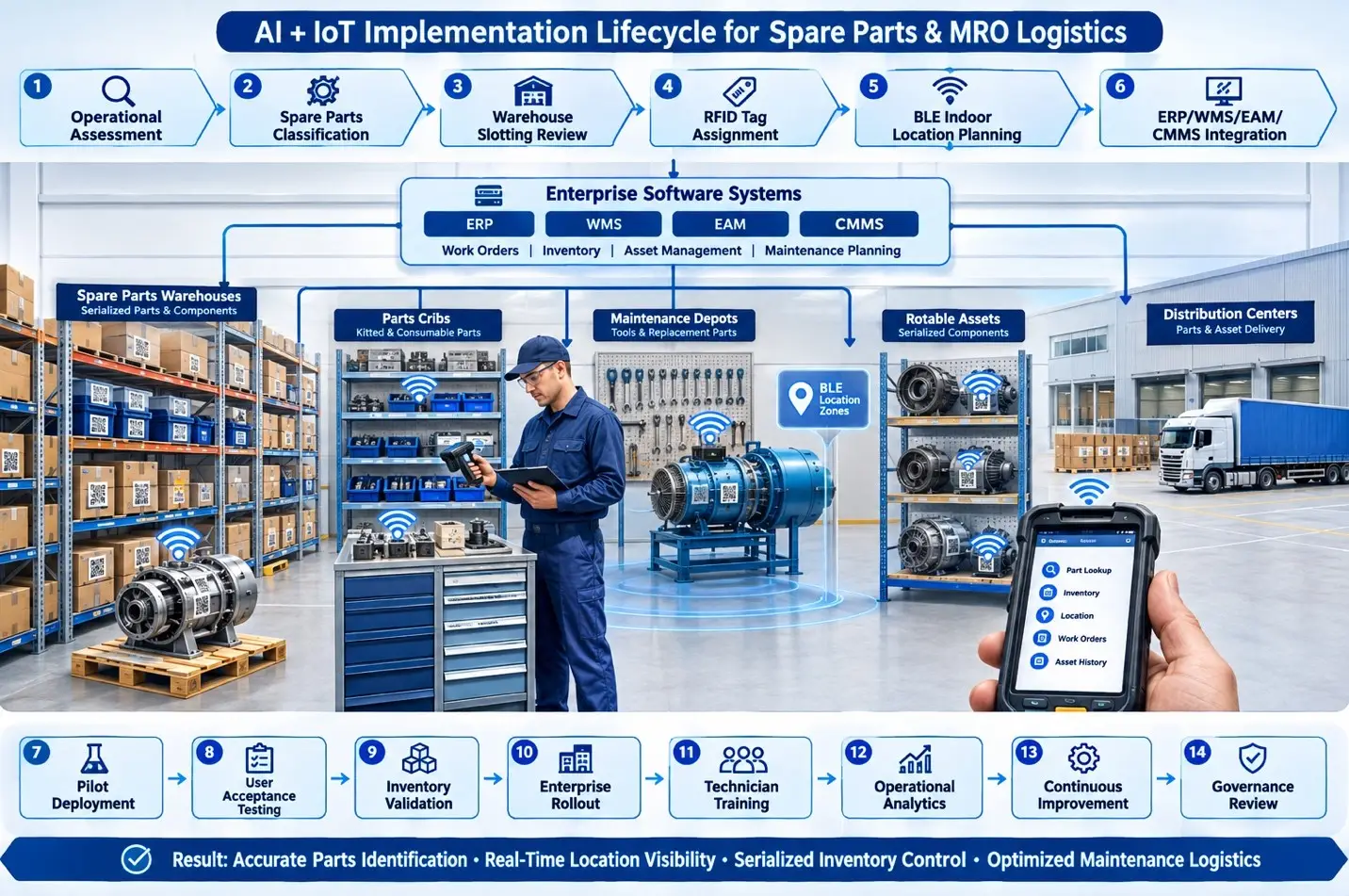
This workflow diagram illustrates the complete enterprise lifecycle for deploying AI + IoT solutions across Spare Parts and MRO Logistics operations, from operational assessment and warehouse planning through enterprise integration, pilot deployment, validation, rollout, training, and continuous improvement. It demonstrates how RFID identification, BLE location services, and ERP/WMS/EAM/CMMS integration work together to improve serialized inventory control, spare parts visibility, maintenance logistics, and enterprise-wide operational governance.
Purpose of the MRO Resources Hub
Enterprise maintenance organizations continuously balance inventory investment against equipment uptime. Excess inventory increases carrying costs, while insufficient inventory can delay maintenance activities, extend equipment downtime, and disrupt production schedules. Successfully managing this balance requires accurate operational data supported by standardized identification and enterprise software integration.
The purpose of the MRO Resources Hub is to provide maintenance organizations with practical technical guidance for planning, deploying, validating, and expanding AI and IoT solutions that improve operational efficiency throughout the maintenance supply chain.
Rather than serving as a marketing resource, this knowledge center functions as a technical reference for professionals responsible for designing, implementing, integrating, and maintaining enterprise Spare Parts & MRO Logistics systems.
Primary objectives include helping organizations:
- Improve inventory accuracy across multiple warehouses
- Increase visibility of serialized repairable assets
- Standardize component identification procedures
- Optimize maintenance material availability
- Reduce manual inventory reconciliation
- Strengthen warehouse governance
- Improve maintenance workflow efficiency
- Simplify enterprise software integration
- Support regulatory compliance
- Improve audit readiness
- Reduce inventory search time
- Improve warehouse labor productivity
- Enhance enterprise reporting consistency
- Standardize operational procedures across multiple maintenance facilities
Each technical document combines implementation guidance with operational best practices that can be adapted to organizations of varying sizes and maintenance environments.
Practical Experience Supporting Enterprise AI and IoT Deployments
Successful AI and IoT implementation extends beyond selecting identification technologies. Enterprise projects require careful planning, standardized business processes, software interoperability, operational validation, workforce adoption, cybersecurity considerations, and continuous operational improvement.
MROLog AI was created within Aperture Venture Studio with support from GAO and builds upon more than two decades of practical IoT experience. The knowledge incorporated throughout this Resources Hub reflects implementation experience gained from thousands of customer deployments across industrial sectors where maintenance logistics plays a critical operational role.
Extensive investments in research and development, rigorous quality assurance practices, and expert remote and onsite technical support enable the guidance provided throughout this knowledge center to reflect proven implementation methodologies rather than theoretical concepts. This experience is further strengthened through collaboration with Ph.D. professionals, industry experts, strategic technology partners, Fortune 500 organizations, leading research institutions, and government agencies throughout the United States and Canada.
As a result, every implementation guide emphasizes operational reliability, enterprise scalability, maintainability, and measurable business outcomes while remaining grounded in the day-to-day realities of Spare Parts & MRO Logistics.
MRO Logistics Documentation
Enterprise Spare Parts & MRO Logistics operations depend on comprehensive technical documentation to ensure inventory accuracy, standardized warehouse procedures, regulatory compliance, and consistent maintenance support across geographically distributed facilities. Every movement of a serialized spare part, rotable component, repairable assembly, maintenance kit, or critical spare should be documented using standardized processes that support operational visibility and enterprise reporting.
The MRO Resources Hub provides implementation-focused documentation that helps organizations establish repeatable procedures for warehouse receiving, put-away, storage, picking, kitting, issue, repair, refurbishment, exchange, core return, and final disposition. Rather than presenting generic warehouse guidance, these resources address the unique operational requirements of maintenance logistics where inventory availability directly affects equipment uptime, preventive maintenance schedules, and service level agreements (SLAs).
Documentation is intended for:
- Warehouse managers
- Maintenance planners
- MRO logistics specialists
- Reliability engineers
- Inventory control supervisors
- Supply chain professionals
- Enterprise architects
- ERP administrators
- WMS administrators
- EAM and CMMS specialists
- Industrial system integrators
- Technical project managers
- Operations managers
- Procurement teams
Core documentation topics include:
- Spare parts warehouse operating procedures
- Serialized component identification standards
- Rotable asset lifecycle documentation
- Parts crib management practices
- Bench stock administration
- Warehouse slotting methodologies
- Material receiving and inspection workflows
- Inventory put-away procedures
- Maintenance material issuance
- Kitting and staging processes
- Repairable asset routing
- Core return management
- Cross-dock material handling
- Multi-site inventory synchronization
- Warehouse cycle counting procedures
- Inventory reconciliation methods
- Material disposition workflows
- Warehouse performance measurement
- Inventory governance policies
- Audit preparation procedures
Every guide emphasizes operational consistency, enterprise scalability, and practical implementation while supporting AI and IoT-enabled identification and location workflows using RFID, BLE, barcode technologies, GPS, Cellular IoT, and LoRaWAN.
Documentation Supporting the Complete MRO Material Lifecycle
Unlike finished goods distribution, Spare Parts & MRO Logistics manages assets that repeatedly circulate through operational lifecycles. A repairable hydraulic pump, aircraft actuator, industrial motor, circuit board, gearbox, or turbine component may move through storage, installation, removal, repair, refurbishment, inspection, and redeployment multiple times during its service life.
Accurate documentation throughout this lifecycle improves traceability and enables maintenance organizations to maintain complete operational histories.
Lifecycle documentation includes:
- Initial receiving verification
- Serialized identification assignment
- Warehouse location registration
- Maintenance work order allocation
- Technician material issuance
- Installation confirmation
- Component removal records
- Repair routing documentation
- Refurbishment tracking
- Functional testing records
- Warranty verification
- Core return processing
- Inventory reclassification
- Warehouse relocation history
- End-of-life disposition
Maintaining standardized documentation across these activities supports accurate inventory records, simplifies warranty management, improves repair planning, and reduces administrative effort during internal and external audits.
AI + IoT Deployment Readiness Checklist for Spare Parts & MRO Logistics: Enterprise Implementation Roadmap
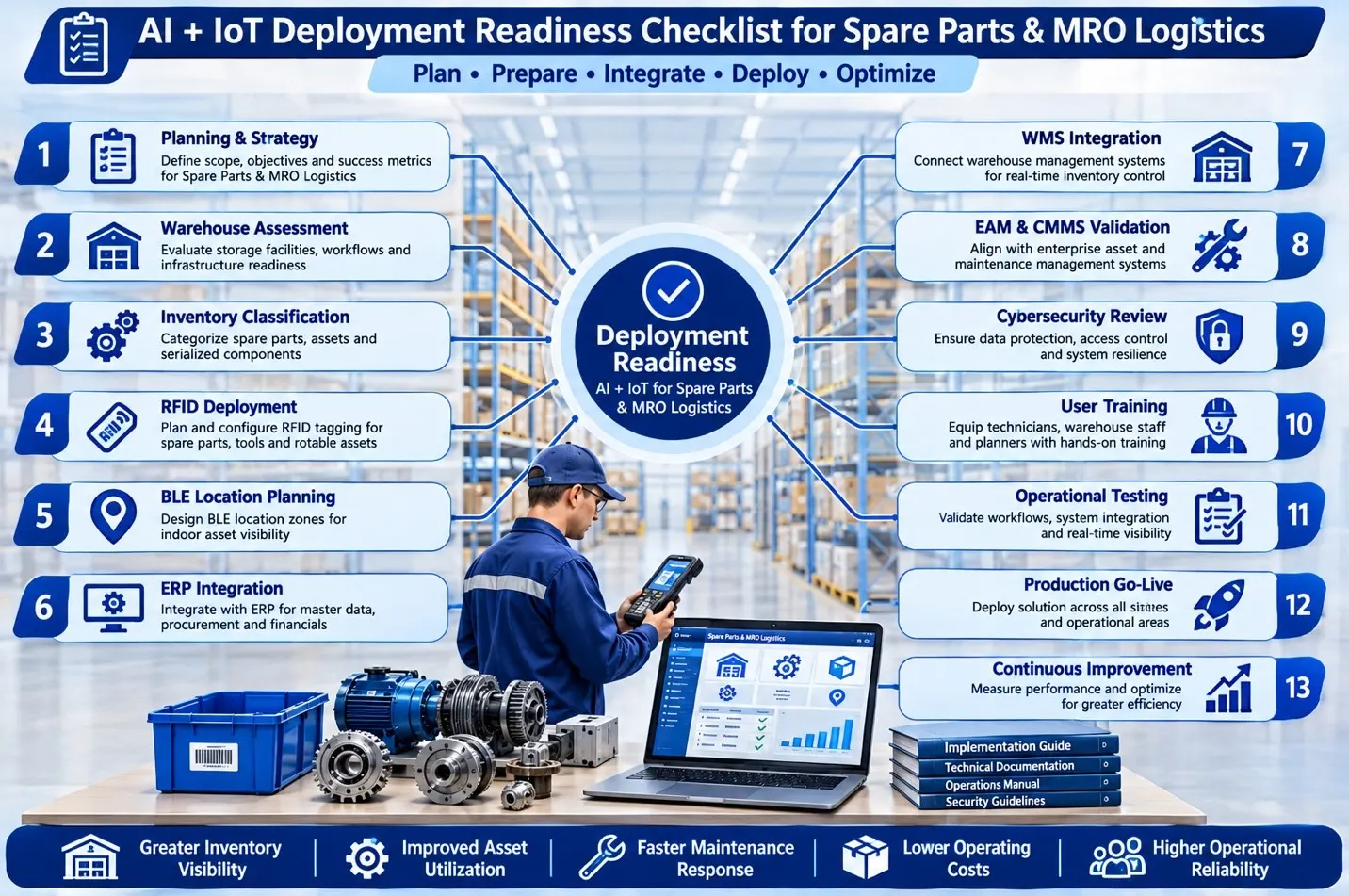
This enterprise deployment readiness infographic outlines the key activities organizations should complete before implementing AI + IoT solutions for Spare Parts & MRO Logistics. It covers planning, warehouse assessment, inventory classification, RFID and BLE deployment, enterprise software integration, cybersecurity, user training, operational testing, production go-live, and continuous improvement. The visual emphasizes structured implementation, serialized inventory governance, real-time location visibility, and seamless integration with enterprise asset and maintenance management systems.
MRO Integration Guides
AI and IoT solutions generate the greatest operational value when identification and location data are exchanged automatically with enterprise software already supporting maintenance, warehousing, procurement, inventory control, and asset management. Rather than creating isolated information repositories, modern implementations should integrate seamlessly with existing enterprise business systems to establish a single, reliable source of operational data.
The integration guidance within this Resources Hub explains practical methods for connecting AI and IoT software with established enterprise applications while preserving existing business workflows.
Typical enterprise integration targets include:
- Enterprise Resource Planning (ERP)
- Warehouse Management Systems (WMS)
- Enterprise Asset Management (EAM)
- Computerized Maintenance Management Systems (CMMS)
- Maintenance Planning Systems
- Procurement and Purchasing Systems
- Inventory Management Software
- Material Requirements Planning (MRP)
- Asset Registry Databases
- Warehouse Execution Systems
- Identity and Access Management Software
- Business Reporting Systems
- Data Warehouses
- Executive Reporting Dashboards
Accurate integration enables inventory movements, technician activities, warehouse transactions, repair orders, serialized component histories, and material consumption records to remain synchronized across enterprise operations.
Enterprise Integration Best Practices
Successful AI and IoT deployments generally follow a structured integration methodology that minimizes operational disruption while maximizing long-term maintainability.
Recommended implementation stages include:
- Current-state business process assessment
- Enterprise software inventory
- Master data review
- Serialized identifier standardization
- Warehouse location normalization
- Interface specification development
- API and middleware configuration
- Data validation procedures
- Security review
- Pilot implementation
- Functional integration testing
- User acceptance testing
- Production rollout
- Operational monitoring
- Continuous optimization
Organizations that establish standardized integration practices typically experience improved inventory accuracy, fewer manual reconciliation activities, and more reliable reporting across enterprise maintenance operations.
Synchronizing Maintenance and Warehouse Operations
Maintenance activities depend on timely material availability, while warehouse operations rely on accurate maintenance demand forecasts. AI and IoT integration bridges these operational domains by enabling information to move efficiently between warehouse personnel, maintenance planners, procurement teams, and field service organizations.
Typical synchronized workflows include:
- Maintenance work order creation
- Automatic material reservation
- Warehouse picking requests
- Parts issue confirmation
- Technician assignment
- Serialized component verification
- Repair order creation
- Inventory updates
- Core return processing
- Procurement replenishment
- Inventory balancing across multiple warehouses
- Executive performance reporting
Integrated workflows reduce duplicate data entry while improving coordination between maintenance and logistics teams.
RFID Implementation Guidance
Radio Frequency Identification (RFID) has become one of the most widely adopted identification technologies within Spare Parts & MRO Logistics because it enables rapid identification of serialized components, repairable inventory, maintenance kits, warehouse bins, and rotable assets without requiring direct line-of-sight scanning.
RFID improves operational efficiency by supporting:
- High-speed inventory counting
- Automated warehouse receiving
- Parts crib identification
- Serialized asset verification
- Rotable component tracking
- Maintenance material issue
- Warehouse transfer validation
- Core return confirmation
- Inventory reconciliation
- Shipment verification
- Warehouse audit preparation
- Multi-site inventory visibility
Properly designed RFID implementations help reduce manual counting activities while improving inventory accuracy across enterprise maintenance supply chains.
RFID Deployment Planning
Successful RFID implementation begins with careful operational planning rather than hardware selection alone.
Planning activities typically include:
- Spare parts classification
- Tag selection strategy
- Metal-compatible RFID evaluation
- Label durability assessment
- Serialized identification standards
- Warehouse layout analysis
- Read zone planning
- Dock door portal positioning
- Handheld reader deployment
- Fixed reader optimization
- Inventory validation procedures
- Exception handling workflows
Organizations should also establish governance procedures defining tag commissioning, identifier management, replacement processes, and lifecycle maintenance to ensure long-term operational consistency.
RFID Best Practices for Spare Parts Warehousing
Recommended RFID implementation practices include:
- Standardize tag placement across identical components.
- Maintain consistent serialized identifier formats.
- Validate read accuracy before production deployment.
- Integrate RFID events directly with ERP and WMS transactions.
- Perform routine reader calibration and validation.
- Document warehouse read zones.
- Establish procedures for damaged tag replacement.
- Validate inventory reconciliation using cycle counts.
- Periodically review warehouse workflows after deployment.
Following these recommendations improves long-term system reliability while minimizing operational interruptions.
BLE Location Deployment
Bluetooth Low Energy (BLE) complements RFID by providing continuous indoor location awareness for personnel, mobile assets, maintenance activities, and controlled warehouse areas. Within Spare Parts & MRO Logistics environments, BLE enables organizations to improve workforce coordination, accelerate material retrieval, strengthen access management, and optimize warehouse labor utilization.
Typical deployment areas include:
- Maintenance depots
- Parts cribs
- Warehouse picking zones
- Repair benches
- Tool rooms
- Inspection stations
- Receiving docks
- Cross-dock facilities
- Staging locations
- Contractor work areas
- High-security component storage
- Multi-building maintenance campuses
BLE location services help reduce search time for technicians and improve operational coordination throughout maintenance facilities.
BLE Deployment Best Practices
A successful BLE implementation begins with detailed facility planning and operational workflow analysis.
Deployment recommendations include:
- Develop detailed digital facility maps.
- Define warehouse and maintenance zones before installation.
- Position BLE infrastructure to support operational workflows.
- Align location zones with warehouse storage locations.
- Integrate personnel credentials with enterprise identity management.
- Validate indoor positioning accuracy under production conditions.
- Establish privacy policies governing workforce location information.
- Document expansion procedures for future facilities.
- Perform periodic coverage verification.
- Review operational performance after deployment.
Proper planning enables organizations to improve technician productivity, reduce unnecessary travel throughout maintenance facilities, and enhance operational visibility without disrupting established warehouse procedures.
Parts Compliance Resources
Enterprise Spare Parts & MRO Logistics operations are governed by strict documentation, inventory governance, quality management, and traceability requirements. Organizations supporting industrial manufacturing, aerospace maintenance, energy generation, mining equipment, rail transportation, utilities, marine operations, and heavy equipment service must maintain complete records for serialized spare parts, repairable assets, rotable components, warranty-controlled inventory, and maintenance materials throughout their operational lifecycle.
Accurate compliance documentation is essential for demonstrating inventory accountability, supporting quality audits, validating maintenance records, and meeting both internal governance policies and external regulatory requirements. AI and IoT solutions strengthen these processes by providing consistent identification, authenticated inventory transactions, and reliable location visibility across maintenance warehouses, distribution centers, repair depots, and field service operations.
This section provides practical technical guidance for establishing compliance-focused identification and documentation procedures within enterprise Spare Parts & MRO Logistics environments.
Primary compliance topics include:
- Serialized spare parts identification standards
- Component genealogy documentation
- Lot and batch record management
- Warranty eligibility verification
- Core return documentation
- Repairable asset lifecycle records
- Warehouse inventory audit procedures
- Material issue accountability
- Receiving inspection documentation
- Chain of custody management
- Contractor material accountability
- Electronic record retention
- Multi-site inventory governance
- Maintenance documentation controls
- Enterprise data integrity procedures
Rather than viewing compliance as an administrative exercise, organizations should integrate documentation directly into operational workflows so that every warehouse transaction, maintenance issue, repair cycle, and inventory movement automatically contributes to a complete and auditable operational history.
Serialized Component Traceability
Many industries supported by Spare Parts & MRO Logistics require complete historical records for every serialized component. Whether managing turbine assemblies, aircraft line replaceable units (LRUs), industrial gearboxes, electric motors, hydraulic pumps, PLC modules, bearings, or critical maintenance assemblies, organizations must maintain accurate lifecycle documentation from acquisition through retirement.
AI and IoT-enabled identification technologies simplify serialized component traceability by automatically associating each movement with its unique identifier and corresponding maintenance activity.
Comprehensive traceability records typically include:
- Original receiving documentation
- Unique serialized identifier
- Warehouse storage history
- Bin and rack location history
- Technician issue records
- Maintenance work order association
- Installation confirmation
- Removal documentation
- Inspection records
- Repair facility routing
- Refurbishment history
- Functional testing results
- Warranty validation
- Exchange unit transactions
- Core return processing
- Inventory relocation history
- Final disposition records
Maintaining this level of documentation improves operational transparency while reducing manual investigation during audits, warranty claims, quality reviews, and maintenance planning activities.
Inventory Governance Best Practices
Inventory governance extends beyond maintaining accurate stock counts. Effective governance establishes standardized procedures that ensure inventory records remain synchronized across warehouses, maintenance depots, forward stocking locations (FSLs), contractor-managed inventory, and enterprise software systems.
Recommended governance practices include:
- Standardize material master records.
- Maintain enterprise-wide location naming conventions.
- Define ownership for every inventory transaction.
- Apply consistent serialized identification policies.
- Establish controlled authorization procedures.
- Perform scheduled inventory reconciliation.
- Maintain documented audit trails.
- Review obsolete inventory regularly.
- Validate inventory classifications.
- Document all inventory adjustments.
- Archive historical inventory transactions.
- Periodically review governance procedures.
Consistent governance improves reporting accuracy while supporting long-term operational reliability across distributed maintenance supply chains.
Deployment Readiness Checklists
Successful AI and IoT implementations begin long before software installation or hardware deployment. Organizations that invest time in structured planning, operational analysis, and technical validation typically experience smoother implementations, faster user adoption, and more sustainable long-term performance.
The Deployment Readiness Checklists provided within this Resources Hub help organizations evaluate organizational readiness across business processes, warehouse operations, software integration, cybersecurity, user training, and operational governance.
Readiness categories include:
- Business objectives documented
- Project governance established
- Warehouse workflows analyzed
- Material classifications completed
- Serialized identification standards approved
- Warehouse location hierarchy verified
- Inventory quality reviewed
- Critical spare classifications validated
- RFID deployment strategy finalized
- BLE location planning completed
- GPS asset tracking requirements reviewed
- Cellular IoT connectivity evaluated
- LoRaWAN coverage planning completed
- ERP integration confirmed
- WMS interfaces documented
- EAM connectivity validated
- CMMS integration reviewed
- Security policies approved
- User access permissions configured
- Backup procedures documented
- Disaster recovery plans verified
- Training materials completed
- Validation procedures documented
- Operational support model established
Completing these activities before implementation reduces project risk while improving deployment consistency across enterprise maintenance operations.
Production Validation Prior to Go-Live
Before production deployment, organizations should validate both technical functionality and operational workflows under realistic operating conditions.
Recommended validation activities include:
- RFID identification accuracy testing
- BLE location verification
- Warehouse location validation
- Serialized component verification
- Inventory reconciliation testing
- Work order integration validation
- ERP transaction verification
- WMS synchronization testing
- EAM asset association validation
- CMMS workflow confirmation
- User credential verification
- Exception handling testing
- Executive reporting validation
- Business continuity verification
- Performance benchmarking
- User acceptance testing (UAT)
- Final production readiness approval
Structured validation minimizes operational disruption while providing confidence that AI and IoT solutions will perform reliably under day-to-day production workloads.
Enterprise Implementation Recommendations
Enterprise AI and IoT initiatives deliver the greatest operational value when technology deployment is aligned with standardized maintenance processes, inventory governance, and long-term operational objectives. Successful implementations prioritize business workflows before selecting identification technologies, ensuring that every deployment supports measurable operational improvements.
Recommended implementation practices include:
- Define enterprise inventory governance before deployment.
- Standardize serialized component identification across all facilities.
- Normalize warehouse location hierarchies.
- Establish consistent naming conventions for bins, racks, and storage zones.
- Integrate AI and IoT software directly with ERP, WMS, EAM, and CMMS environments.
- Develop documented exception management procedures.
- Conduct phased pilot deployments before enterprise expansion.
- Monitor inventory accuracy using measurable key performance indicators (KPIs).
- Perform routine operational reviews following implementation.
- Maintain current technical documentation throughout the system lifecycle.
- Train warehouse personnel and maintenance technicians using standardized procedures.
- Establish governance committees responsible for long-term operational improvement.
Organizations following these practices generally experience improved inventory visibility, reduced material search times, greater warehouse productivity, higher maintenance responsiveness, and stronger enterprise reporting consistency.
Frequently Asked Questions
The Resources Hub is designed for organizations managing enterprise maintenance logistics, including industrial manufacturers, utilities, energy providers, aerospace maintenance organizations, mining companies, rail operators, marine service providers, heavy equipment fleets, and industrial field service organizations that rely on accurate spare parts availability and serialized inventory management.
The documentation focuses on enterprise identification and location technologies commonly deployed within Spare Parts & MRO Logistics, including RFID, BLE, barcode systems, GPS, Cellular IoT, and LoRaWAN. Practical implementation guidance is also provided for enterprise software integration and warehouse operations.
Yes. The guidance explains integration strategies for Enterprise Resource Planning (ERP), Warehouse Management Systems (WMS), Enterprise Asset Management (EAM), Computerized Maintenance Management Systems (CMMS), procurement software, inventory databases, maintenance planning applications, and executive reporting solutions.
Yes. The documentation supports centralized warehouses, regional distribution centers, maintenance depots, contractor-managed inventory locations, forward stocking locations (FSLs), field service operations, and globally distributed maintenance supply chains requiring standardized inventory governance and enterprise-wide visibility.
Spare Parts & MRO Logistics depends on accurate identification, authenticated inventory transactions, serialized component traceability, personnel accountability, and warehouse location visibility. These capabilities form the operational foundation for inventory accuracy, maintenance planning, regulatory compliance, and enterprise supply chain coordination.
Why Choose MROLog AI
Selecting an AI and IoT solution for Spare Parts & MRO Logistics involves more than choosing identification technologies or enterprise software. Long-term operational success depends on implementation experience, deep knowledge of maintenance logistics workflows, enterprise integration expertise, and proven methodologies for managing serialized spare parts, rotable assets, repairable inventory, and distributed warehouse operations.
MROLog AI specializes in AI and IoT solutions that improve identification, location visibility, inventory governance, and maintenance material management throughout the enterprise maintenance supply chain. Our technical approach is centered on practical operational improvements that help organizations reduce inventory discrepancies, improve warehouse productivity, accelerate maintenance response, strengthen traceability, and support continuous operational improvement.
Rather than promoting generic digital transformation initiatives, we focus on solving the day-to-day operational challenges encountered in:
- Spare parts warehouses
- Maintenance depots
- Regional distribution centers
- Parts cribs
- Repair facilities
- Forward stocking locations (FSLs)
- Contractor-managed inventory
- Field service logistics
- Multi-site maintenance supply chains
- Enterprise service parts distribution
Our implementation guidance is written for maintenance engineers, warehouse managers, inventory planners, logistics professionals, enterprise architects, system integrators, procurement teams, IT professionals, and operations leaders responsible for maintaining reliable maintenance supply chain operations.
Built on Proven Enterprise AI and IoT Experience
MROLog AI was created within Aperture Venture Studio with support from GAO and is built upon more than two decades of practical IoT experience across industrial operations. The implementation guidance throughout this Resources Hub reflects knowledge gained from thousands of successful customer deployments involving identification, location visibility, warehouse modernization, enterprise integration, and maintenance logistics optimization.
This experience enables us to provide documentation that addresses real operational challenges, including:
- Inventory accuracy improvement
- Serialized component governance
- Warehouse workflow optimization
- Maintenance material availability
- Multi-site inventory synchronization
- Repairable asset lifecycle management
- Enterprise software interoperability
- Warehouse audit preparation
- Deployment risk reduction
- Operational validation
Significant investments in research and development, comprehensive quality assurance procedures, and expert technical support ensure that implementation guidance remains technically accurate, operationally practical, and aligned with current enterprise practices.
Technical Leadership Supporting Complex Maintenance Operations
Enterprise maintenance environments require multidisciplinary expertise spanning logistics, warehouse operations, enterprise software, identification technologies, and industrial systems integration.
MROLog AI is supported by Ph.D. professionals from leading universities together with experienced engineers, industrial AI and IoT specialists, enterprise software experts, warehouse automation consultants, and maintenance logistics professionals. Over the years, our broader organization has supported Fortune 500 companies, major research institutions, leading universities, and government agencies throughout the United States and Canada.
This combination of academic expertise and practical deployment experience enables the Resources Hub to deliver technical guidance that balances engineering precision with operational applicability.
Continuous Knowledge for Modern Maintenance Logistics
Maintenance supply chains continue to evolve as organizations expand distributed warehouse networks, improve inventory governance, modernize maintenance operations, and integrate AI and IoT technologies into enterprise business processes. Keeping pace with these changes requires access to current implementation guidance, evolving best practices, and practical engineering references.
The MRO Resources Hub is continuously expanded to address emerging operational requirements across Spare Parts & MRO Logistics.
Future technical resources include:
- Enterprise AI and IoT implementation white papers
- RFID warehouse deployment case studies
- BLE indoor location planning references
- Warehouse inventory governance templates
- Serialized component lifecycle guides
- Rotable asset administration references
- Enterprise integration examples
- ERP, WMS, EAM, and CMMS configuration guidance
- Maintenance logistics workflow optimization
- Warehouse slotting methodologies
- Deployment validation procedures
- Operational KPI measurement frameworks
- Regulatory documentation references
- Enterprise implementation checklists
These resources help organizations improve operational maturity while maintaining standardized maintenance logistics practices across multiple facilities and business units.
Advancing Enterprise Spare Parts & MRO Logistics
Enterprise Spare Parts & MRO Logistics plays a vital role in maintaining equipment availability, supporting maintenance execution, and ensuring operational continuity across industrial organizations. Achieving these objectives requires more than maintaining inventory levels. Organizations must establish standardized identification methods, accurate warehouse records, reliable location visibility, robust inventory governance, and seamless integration with enterprise business systems.
AI and IoT technologies including RFID, BLE, GPS, Cellular IoT, LoRaWAN, and enterprise identification software provide the foundation for modern maintenance logistics by improving serialized component traceability, warehouse inventory accuracy, maintenance material availability, personnel accountability, and enterprise-wide operational visibility. When combined with ERP, WMS, EAM, and CMMS integration, these capabilities enable maintenance organizations to streamline material flows, reduce manual processes, strengthen compliance, and improve decision-making across distributed maintenance supply chains.
The MRO Resources Hub from MROLog AI serves as a comprehensive technical knowledge center supporting every phase of an enterprise AI and IoT implementation. From deployment planning and warehouse modernization to compliance guidance, integration strategies, operational validation, and long-term optimization, the Resources Hub provides practical engineering information designed specifically for maintenance logistics professionals.
As maintenance organizations continue to modernize warehouses, expand regional distribution networks, and increase reliance on serialized spare parts and repairable assets, adopting standardized AI and IoT identification and location solutions will remain essential for improving maintenance efficiency, inventory accuracy, service responsiveness, and long-term operational resilience.
Contact Our Technical Specialists
Whether your organization is planning an initial AI and IoT deployment, expanding warehouse modernization initiatives, or integrating enterprise maintenance software across multiple facilities, our technical specialists can help develop an implementation strategy aligned with your operational objectives.
Engaging technical specialists during the planning stage helps organizations establish realistic implementation objectives, reduce deployment risk, improve integration quality, and accelerate operational adoption across maintenance logistics environments.
Get in Touch