
IoT Hardware Technologies for AIoT-Enabled Spare Parts & MRO Logistics Overview
Enterprise AIoT deployments begin with dependable identification hardware capable of accurately recognizing people, inventory, assets, storage locations, transport equipment, and warehouse transactions. Reliable identification serves as the digital foundation upon which AI software performs operational analysis, inventory optimization, warehouse planning, workforce coordination, and logistics decision support.
Unlike conventional inventory systems that depend heavily on manual barcode entry or periodic physical counts, AI and IoT-enabled identification technologies continuously capture operational events throughout maintenance workflows. Every spare part received, warehouse transfer completed, technician assignment, rotable asset exchange, repair cycle, warranty return, inventory issue, and core return generates trusted identification records that improve operational visibility.
Modern Spare Parts & MRO Logistics operations commonly deploy multiple identification technologies because each technology addresses a specific operational requirement.
Typical enterprise hardware includes:
- Passive UHF RFID tags
- Industrial barcode labels
- Fixed RFID readers
- Mobile RFID readers
- RFID portal systems
- Vehicle-mounted RFID readers
- Rugged handheld barcode scanners
- Industrial mobile computers
- BLE employee badges
- BLE asset tags
- GPS fleet tracking devices
- Cellular IoT communication gateways
- LoRaWAN gateways
- Industrial label printers
- Warehouse identification terminals
- Vehicle identification devices
Each technology contributes unique operational capabilities.
RFID enables rapid identification of serialized spare parts, pallets, maintenance kits, rotable components, repair assemblies, reusable containers, and warehouse inventory without requiring direct line-of-sight scanning.
Barcode technologies provide cost-effective identification for storage bins, maintenance consumables, picking locations, replacement parts, shipping cartons, warehouse shelves, and inventory transactions requiring manual confirmation.
BLE enhances indoor personnel location awareness, secure parts crib access, contractor verification, workforce coordination, warehouse zone occupancy analysis, and technician movement visibility throughout maintenance facilities.
GPS supports outdoor visibility of maintenance fleets, emergency spare parts deliveries, mobile repair units, field service inventory, and transportation of high-value rotable assets between maintenance locations.
Cellular IoT enables continuous communication between remote maintenance facilities and enterprise software, allowing field service vehicles, regional depots, and temporary maintenance sites to exchange operational data even where local wired infrastructure is unavailable.
LoRaWAN extends long-range wireless connectivity across expansive maintenance campuses, outdoor storage yards, heavy equipment depots, rail maintenance facilities, utility service centers, mining maintenance operations, and geographically distributed warehouse networks.
Rather than selecting one identification technology for every operational scenario, mature maintenance organizations combine RFID, barcode, BLE, GPS, Cellular IoT, and LoRaWAN into a unified identification strategy. This layered approach provides comprehensive visibility from warehouse receiving through inventory storage, technician issuing, maintenance execution, repair processing, reverse logistics, refurbishment, warranty management, and final inventory replenishment.
AI software continuously analyzes identification events generated by these technologies to improve warehouse slotting strategies, identify inventory bottlenecks, optimize stock replenishment, reduce excess inventory, improve technician productivity, strengthen serialized component genealogy, and increase warehouse throughput without disrupting established maintenance workflows.
MROLog AI develops enterprise AI and IoT solutions for Spare Parts & MRO Logistics based on practical industrial experience gained through more than two decades of IoT innovation supported by GAO. Built upon thousands of successful deployments, extensive research and development, rigorous quality assurance practices, and guidance from Ph.D.-led engineering teams, our solutions help organizations modernize maintenance logistics while integrating with existing enterprise software. This experience includes supporting Fortune 500 manufacturers, industrial research organizations, universities, utilities, transportation operators, and U.S. and Canadian government agencies implementing large-scale identification and location solutions.
MRO Parts Identification Devices
Accurate identification is the operational foundation of modern Spare Parts & MRO Logistics. Every maintenance work order, warehouse transaction, emergency spare parts request, inventory transfer, core return, rotable asset exchange, warranty claim, and refurbishment process depends on the ability to identify the correct component at the correct location and time.
Industrial identification devices eliminate many of the inefficiencies associated with manual inventory management by enabling fast, repeatable, and highly accurate data capture throughout maintenance operations. These devices generate trusted identification events that support AI and IoT software, warehouse management software, maintenance management software, and enterprise business systems without interrupting normal warehouse activities.
Unlike consumer-grade equipment, enterprise identification devices are engineered for demanding industrial environments where they may be exposed to dust, vibration, temperature variations, heavy equipment traffic, and continuous daily operation. Rugged construction, long service life, high read reliability, and compatibility with industrial communication standards make these technologies well suited for maintenance-intensive operations.
Common enterprise identification hardware includes:
- Passive UHF RFID tags for serialized spare parts
- Durable barcode labels for maintenance inventory
- Direct part marking (DPM) identification for metal components where applicable
- Rugged handheld barcode scanners
- Rugged handheld RFID readers
- Fixed RFID readers
- RFID portal readers
- Vehicle-mounted RFID readers
- Industrial mobile computers
- Wearable mobile data terminals
- Industrial barcode label printers
- RFID label printers
- Technician identification badges
- Warehouse location labels
- Shelf and rack identification markers
- Tool identification tags
- Rotable asset identification labels
- Returnable transport item identification tags
Each device supports a specific stage of the maintenance logistics lifecycle.
Barcode scanners remain an economical solution for receiving, picking, issuing, cycle counting, shipping verification, warranty processing, and warehouse replenishment activities. RFID readers automate high-volume identification at warehouse portals, storage zones, conveyor interfaces, repair stations, and loading docks without requiring direct line-of-sight scanning. Rugged handheld computers combine multiple identification technologies into a single device, allowing warehouse personnel and maintenance technicians to perform inventory transactions, work order verification, and serialized component validation while remaining mobile throughout the facility.
Organizations managing hundreds of thousands of maintenance items frequently deploy standardized identification hardware across every warehouse and depot to maintain consistent inventory accuracy throughout geographically distributed operations. Standardization also simplifies employee training, maintenance procedures, software integration, and operational governance.
AI software processes identification events collected by these devices to improve warehouse slotting strategies, identify frequently accessed inventory, optimize replenishment timing, reduce search time for critical service parts, and strengthen inventory accuracy across multiple storage locations.
AI + IoT-Enabled Spare Parts & MRO Logistics Enterprise Architecture for Intelligent Identification, Inventory Visibility, and Maintenance Operations
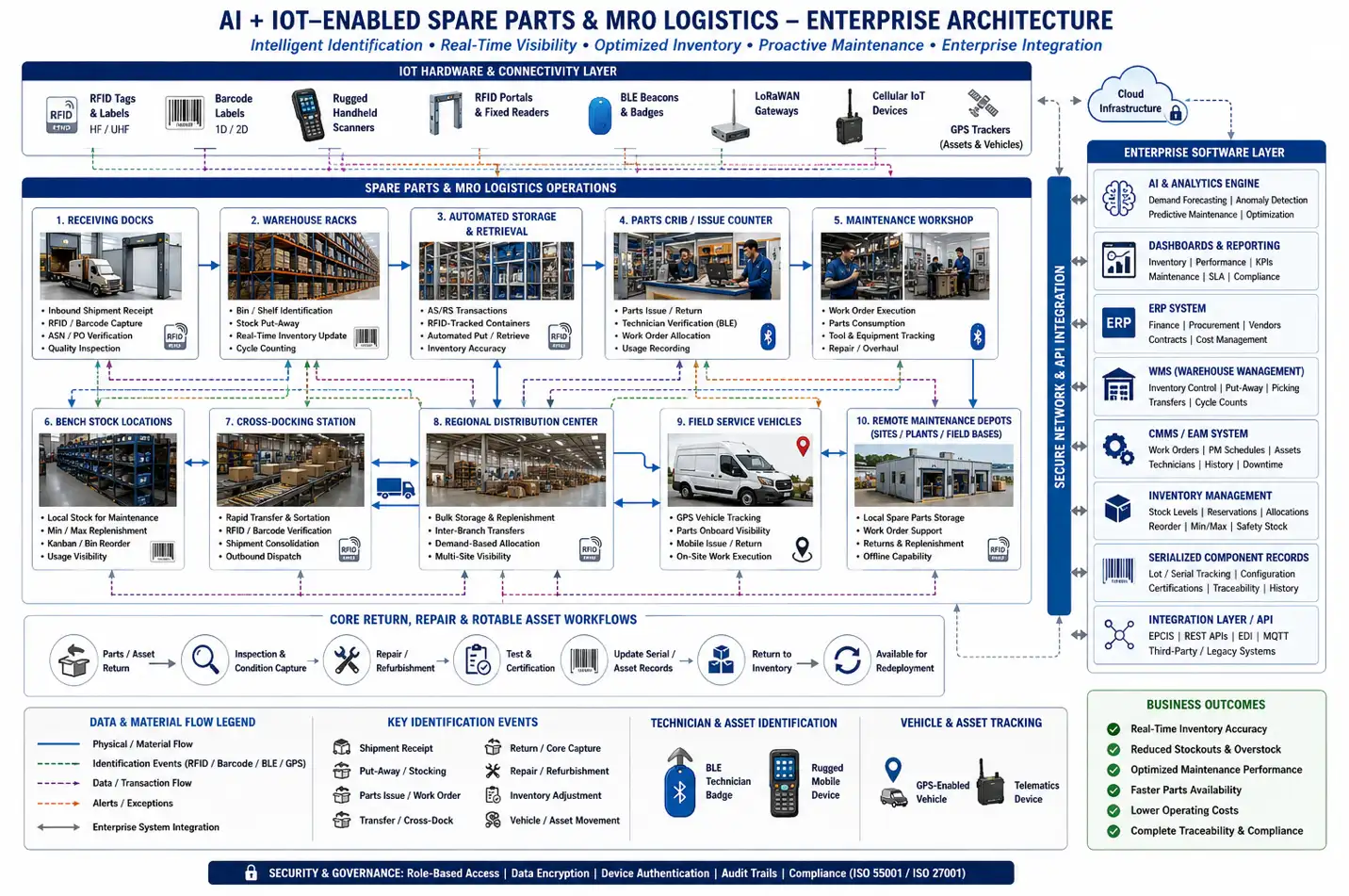
This enterprise architecture diagram illustrates how AI and Industrial IoT technologies integrate identification hardware, connected infrastructure, and enterprise software to support modern Spare Parts and MRO Logistics operations. It demonstrates end-to-end visibility across receiving, warehousing, maintenance workshops, field service, distribution centers, and remote depots while showing how RFID, barcode, BLE, GPS, and IoT devices continuously exchange data with ERP, WMS, CMMS, EAM, and AI analytics platforms to improve inventory accuracy, asset traceability, maintenance efficiency, and lifecycle management.
Typical Identification Workflows Supported
Enterprise identification devices streamline numerous maintenance logistics activities, including:
- Spare parts receiving and inspection
- Warehouse put-away confirmation
- Storage location verification
- Parts picking and order fulfillment
- Technician issue transactions
- Emergency maintenance requests
- Rotable asset exchanges
- Bench stock replenishment
- Tool checkout and return
- Multi-warehouse inventory transfers
- Cross-docking verification
- Shipping confirmation
- Serialized component validation
- Warranty documentation
- Core return processing
- Reverse logistics operations
- Refurbishment tracking
- Maintenance work order verification
- Inventory cycle counting
- Physical inventory reconciliation
These standardized workflows improve inventory integrity while reducing manual data entry and minimizing operational errors across maintenance supply chains.
AI and RFID for Spare Parts Logistics
Radio Frequency Identification (RFID) has become one of the most widely deployed identification technologies in Spare Parts & MRO Logistics because it enables rapid, automated identification of inventory, serialized components, and rotable assets with minimal manual intervention. RFID significantly improves inventory visibility while supporting faster warehouse operations and more reliable maintenance logistics.
Passive UHF RFID is particularly well suited for maintenance warehouses because large numbers of tagged items can be identified simultaneously without requiring direct visual alignment between the tag and the reader. This capability accelerates receiving, warehouse transfers, inventory audits, shipping verification, and work order fulfillment while reducing manual scanning effort.
Typical RFID deployments include:
- Serialized replacement parts
- Rotable assemblies
- Maintenance kits
- Repairable components
- Tool cribs
- Calibration equipment
- Warehouse pallets
- Returnable containers
- Shelf-level inventory
- High-value maintenance assets
- Shipping containers
- Core return inventory
- Cross-dock staging areas
- Distribution center receiving docks
AI software analyzes RFID identification events to provide actionable operational insights, including inventory movement history, warehouse utilization trends, stock rotation patterns, replenishment priorities, demand forecasting, and warehouse throughput analysis. Historical RFID data also supports predictive inventory planning by identifying recurring maintenance demand and seasonal consumption patterns.
Fixed RFID readers installed at receiving docks, warehouse entrances, conveyor interfaces, and storage aisles automatically capture inventory movement without interrupting logistics workflows. Mobile RFID readers extend this capability by allowing warehouse personnel to perform rapid inventory verification, locate missing components, and validate serialized assets directly on the warehouse floor.
RFID technology also strengthens component genealogy by maintaining a complete identification history from initial receipt through storage, issuance, installation, repair, refurbishment, warranty processing, and eventual retirement. This lifecycle visibility supports regulatory compliance, maintenance documentation, quality assurance, and asset lifecycle management.
Organizations supporting critical infrastructure, heavy industry, utilities, mining, transportation, and energy operations frequently use RFID to maintain continuous visibility of high-value maintenance inventory where rapid availability directly affects equipment uptime.
AI and BLE for MRO Facilities
Bluetooth Low Energy (BLE) provides highly effective indoor location capabilities for personnel, mobile maintenance assets, and controlled warehouse areas where continuous position awareness supports operational efficiency and security. Within Spare Parts & MRO Logistics, BLE complements RFID by improving visibility of technician movement, controlled access activities, and mobile asset utilization inside maintenance facilities.
BLE infrastructure typically consists of wearable identification badges, BLE asset tags, fixed gateways, and enterprise software that continuously processes indoor location events. The technology is particularly valuable in large maintenance campuses where technicians regularly move between repair workshops, parts cribs, warehouses, tool rooms, staging areas, and administrative facilities.
Typical BLE applications include:
- Maintenance technician location awareness
- Parts crib access verification
- Contractor identification
- Visitor movement logging
- Warehouse zone occupancy
- Tool room authorization
- Secure storage access
- Mobile equipment location
- Team coordination
- Emergency personnel accountability
- Shift activity analysis
- Workforce utilization reporting
- Restricted maintenance area access
- Temporary work zone management
BLE-generated location events enable AI software to identify operational patterns such as technician travel distances, response times, work distribution, warehouse congestion, idle movement, and access activity. These operational insights support better workforce planning, warehouse layout improvements, and more efficient maintenance scheduling.
BLE also enhances security by supporting automated credential verification before allowing entry into controlled storage areas containing serialized components, aviation parts, hazardous maintenance materials, regulated inventory, or high-value replacement equipment. Zone-based authorization policies help ensure that only qualified personnel can access designated maintenance locations.
When integrated with warehouse management software and maintenance management systems, BLE improves coordination between warehouse staff and maintenance teams while reducing delays associated with locating technicians or mobile equipment.
Operational Benefits of BLE
BLE technology helps organizations achieve:
- Improved technician visibility
- Faster personnel coordination
- Better workforce utilization
- Reduced search time for maintenance teams
- Enhanced warehouse security
- Automated access verification
- Improved contractor accountability
- Better emergency response coordination
- More efficient maintenance scheduling
- Improved warehouse traffic analysis
- Enhanced labor productivity reporting
- Greater visibility across large maintenance facilities
AI and GPS and Cellular IoT for MRO Fleets
Spare Parts & MRO Logistics extends well beyond warehouse operations. Critical replacement components, rotable assemblies, maintenance tools, calibration equipment, repair kits, contractor inventory, and field service materials are continuously transported between central distribution centers, regional MRO depots, customer facilities, manufacturing plants, utilities, mining operations, energy sites, transportation hubs, and remote industrial locations. Maintaining continuous visibility throughout these logistics activities is essential for minimizing equipment downtime and ensuring maintenance readiness.
Global Positioning System (GPS) technology provides precise outdoor location awareness for vehicles and mobile assets, while Cellular IoT delivers reliable wide-area communications that connect those mobile resources with enterprise software. Together, GPS and Cellular IoT create a highly effective solution for managing field maintenance logistics, emergency parts deliveries, mobile inventory, and geographically dispersed maintenance operations.
Unlike RFID and BLE, which primarily support warehouse and facility identification, GPS excels in monitoring assets across public roads, industrial campuses, remote work sites, and interfacility transportation routes. Cellular IoT securely transmits identification events, route information, and operational status from virtually any connected field location, ensuring that maintenance coordinators receive timely updates regardless of where inventory is moving.
Typical GPS and Cellular IoT deployments include:
- Field service vehicles
- Emergency spare parts delivery trucks
- Mobile maintenance workshops
- Utility maintenance fleets
- Mining service vehicles
- Heavy equipment support vehicles
- Mobile calibration laboratories
- Contractor service fleets
- Portable maintenance containers
- Mobile repair trailers
- Rotable asset transportation
- High-value equipment transport
- Temporary project inventory
- Interfacility warehouse transfers
- Regional distribution vehicles
- Mobile parts replenishment units
Real-time GPS visibility enables dispatchers to determine the exact location of maintenance vehicles transporting urgent replacement parts, allowing rapid rerouting when priorities change. This capability is especially valuable during unplanned equipment failures where reducing travel time directly contributes to faster repairs and improved operational continuity.
Cellular IoT provides continuous connectivity between remote maintenance operations and enterprise software. Field technicians, service vehicles, and regional depots can exchange operational information with ERP, WMS, CMMS, EAM, inventory management software, and transportation management systems without relying on local wired infrastructure.
AI software processes GPS and Cellular IoT identification events to support operational improvements such as:
- Delivery route optimization
- Technician dispatch optimization
- Fleet utilization analysis
- Mobile inventory visibility
- Emergency maintenance coordination
- Vehicle arrival prediction
- Interfacility inventory transfers
- Spare parts delivery prioritization
- Route efficiency analysis
- Regional warehouse balancing
- Transportation cost optimization
- Field service scheduling
- Asset movement history
- Contractor fleet coordination
- Service level performance analysis
- Logistics exception management
Historical route information also provides valuable operational solutions. Organizations can identify recurring transportation delays, optimize depot placement, improve technician scheduling, reduce fuel consumption, and increase fleet productivity while maintaining comprehensive movement records for valuable maintenance inventory and rotable assets.
GPS and Cellular IoT are particularly important for organizations supporting geographically distributed operations, including electric utilities, renewable energy providers, mining companies, rail operators, manufacturers, oil and gas facilities, pipeline operators, heavy equipment fleets, and industrial service organizations where maintenance assets routinely travel long distances between operational sites.
When combined with RFID-based warehouse identification and BLE-based indoor workforce visibility, GPS and Cellular IoT provide continuous operational awareness from warehouse receiving through field installation and eventual asset return.
RFID-Enabled Lifecycle of Serialized Spare Parts for AI-Driven Enterprise Maintenance and MRO Logistics
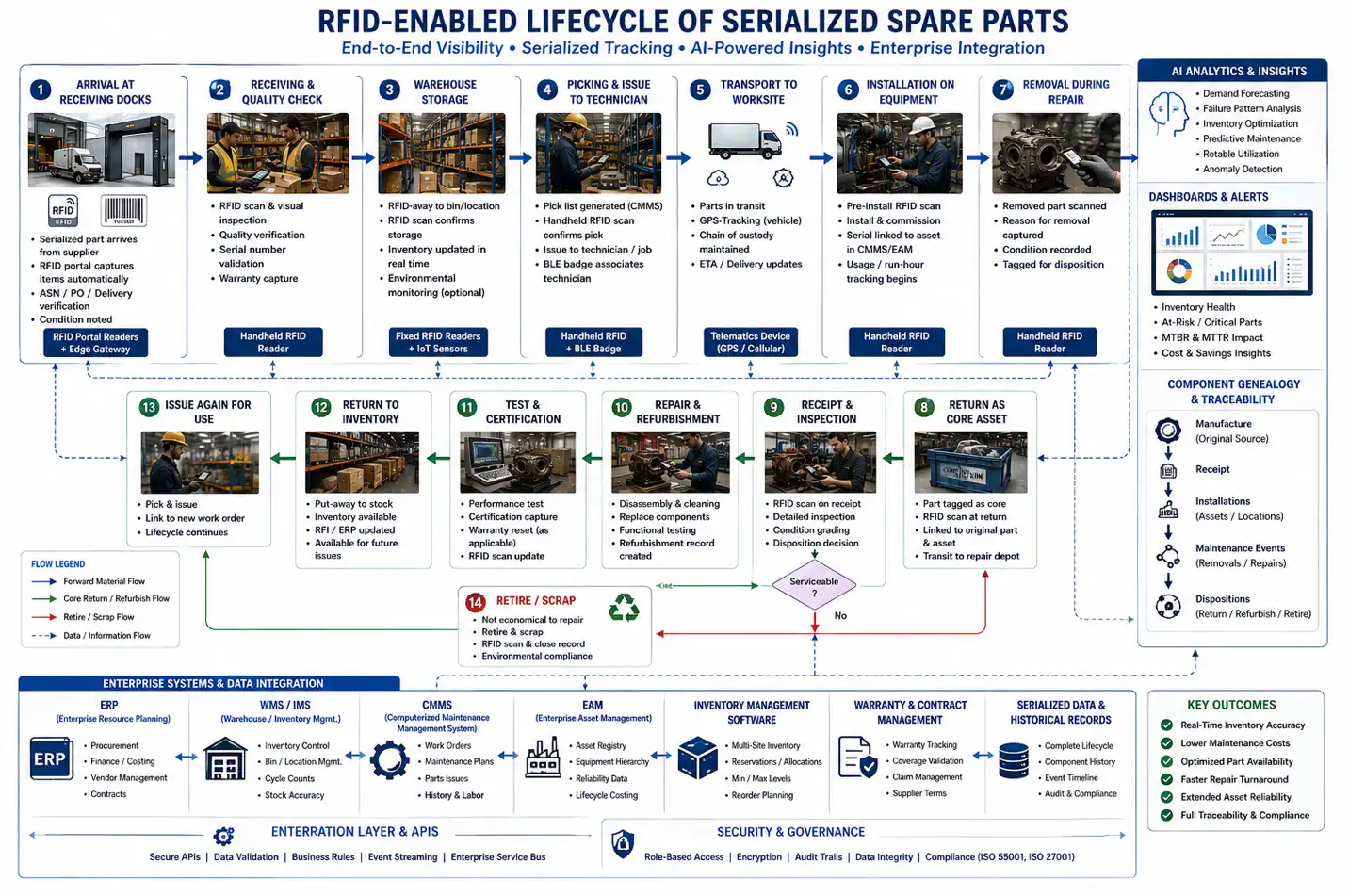
This workflow diagram illustrates the complete RFID-enabled lifecycle of serialized spare parts within an enterprise maintenance environment. It follows components from receiving and warehouse storage through issuance, installation, maintenance, core return, inspection, refurbishment, reintegration into inventory, or retirement while demonstrating integration with AI analytics, ERP, WMS, CMMS, EAM, inventory management, warranty records, and component genealogy to enable complete lifecycle traceability and optimized maintenance operations.
Operational Advantages of GPS and Cellular IoT
Enterprise deployments provide measurable operational improvements, including:
- Continuous visibility of mobile maintenance inventory
- Faster emergency spare parts delivery
- Improved technician dispatch efficiency
- Better fleet utilization
- Reduced transportation delays
- Accurate estimated arrival times
- Improved route planning
- Enhanced regional inventory coordination
- Better contractor logistics visibility
- Improved rotable asset transportation
- Reduced manual fleet reporting
- Comprehensive logistics history
- Better maintenance response performance
- Improved field service coordination
AI and LoRaWAN for Parts Depots
Many Spare Parts & MRO Logistics operations extend across expansive industrial campuses, regional distribution centers, maintenance depots, equipment yards, rail terminals, utility service centers, mining complexes, renewable energy facilities, and outdoor storage areas. These environments often require dependable long-range communications that support identification technologies across large geographic areas while minimizing communication infrastructure.
LoRaWAN (Long Range Wide Area Network) provides long-distance, low-power wireless connectivity that complements RFID, BLE, GPS, and Cellular IoT. Rather than replacing these technologies, LoRaWAN extends identification coverage across facilities where distributed inventory, outdoor equipment storage, and multiple warehouse locations must remain connected through a unified AI and IoT solution.
Because a single LoRaWAN gateway can support communications across extensive operational areas, organizations can connect geographically dispersed maintenance assets while reducing infrastructure complexity and communication costs.
Typical deployment environments include:
- Outdoor spare parts storage yards
- Regional maintenance depots
- Heavy equipment storage areas
- Fleet maintenance facilities
- Utility maintenance campuses
- Mining maintenance yards
- Rail maintenance terminals
- Renewable energy service centers
- Industrial manufacturing campuses
- Pipeline maintenance depots
- Multi-building warehouse complexes
- Contractor equipment staging areas
- Container storage yards
- Temporary project logistics bases
- Distribution center overflow storage
- Regional inventory consolidation hubs
AI software analyzes identification events received through LoRaWAN connectivity to improve inventory distribution, warehouse coordination, depot utilization, material availability, transportation planning, and regional logistics performance.
Common LoRaWAN-supported operational activities include:
- Long-range warehouse identification
- Outdoor inventory visibility
- Depot-wide asset location
- Yard equipment identification
- Multi-site inventory coordination
- Regional warehouse balancing
- Equipment staging management
- Warehouse transfer validation
- Maintenance material distribution
- Remote storage identification
- Industrial campus logistics
- Cross-depot inventory visibility
- Enterprise logistics coordination
- Temporary inventory deployment
- Large-site warehouse operations
One of LoRaWAN's major advantages is its ability to support battery-powered identification devices that operate for extended periods without frequent maintenance. This characteristic makes LoRaWAN particularly suitable for outdoor logistics assets, returnable transport equipment, remote maintenance inventory, and distributed warehouse infrastructure.
Organizations operating regional maintenance networks frequently implement a layered identification strategy consisting of RFID inside warehouses, BLE for personnel visibility, GPS for transportation, Cellular IoT for remote communications, and LoRaWAN for wide-area depot coverage. This integrated approach delivers comprehensive operational visibility across the complete maintenance logistics lifecycle.
End-to-End MRO Field Service Logistics Workflow with GPS and Cellular IoT Integration
This workflow diagram illustrates how GPS and Cellular IoT enable end-to-end MRO field service logistics, from central warehouses and regional distribution centers to field technicians and customer facilities. It shows real-time asset tracking, spare parts dispatch, emergency replenishment, return logistics, and continuous data exchange with AI analytics, ERP, WMS, CMMS, EAM, transportation management systems, and executive dashboards for improved operational visibility and service performance.
Benefits of LoRaWAN in Distributed MRO Logistics
- Long-range communication coverage
- Reduced communication infrastructure
- Improved outdoor inventory visibility
- Better regional warehouse coordination
- Reliable multi-site connectivity
- Efficient depot-wide identification
- Improved asset availability
- Better logistics planning
- Lower operational maintenance requirements
- Enhanced warehouse scalability
- Greater visibility across industrial campuses
- Improved enterprise coordination
Enterprise Software Integration for Spare Parts & MRO Logistics
Industrial identification hardware delivers maximum business value when integrated with enterprise software that coordinates maintenance operations, warehouse execution, inventory control, procurement, transportation, warranty administration, and asset lifecycle management. Every identification event captured through RFID, barcode, BLE, GPS, Cellular IoT, or LoRaWAN becomes actionable operational information when exchanged automatically with enterprise applications.
Typical enterprise software integrations include:
- Enterprise Resource Planning (ERP)
- Warehouse Management Systems (WMS)
- Computerized Maintenance Management Systems (CMMS)
- Enterprise Asset Management (EAM)
- Inventory Management Software
- Procurement and Purchasing Software
- Transportation Management Systems (TMS)
- Workforce Management Software
- Access Control Software
- Warranty Management Software
- Quality Management Software
- Manufacturing Execution Systems (MES), where maintenance operations interface with production
- Business Analytics Software
- Executive Operations Dashboards
Integrated identification workflows support the complete maintenance logistics lifecycle, including receiving, put-away, inventory verification, stock transfers, parts picking, technician issue, work order fulfillment, refurbishment, warranty processing, reverse logistics, core return management, and inventory replenishment. Automated synchronization between identification hardware and enterprise software reduces manual data entry, minimizes transaction errors, and improves operational consistency across all warehouse locations.
AI software further enhances these integrations by analyzing historical identification records to identify recurring maintenance demand, optimize reorder points, improve warehouse slotting, balance inventory across multiple facilities, and highlight operational exceptions requiring management attention. These insights support more accurate maintenance planning and better utilization of critical spare parts inventory.
MROLog AI delivers AI and IoT solutions designed to integrate with existing enterprise software investments while minimizing operational disruption. Developed through more than two decades of industrial IoT experience supported by GAO, the company's solutions reflect thousands of successful deployments, extensive research and development, rigorous quality assurance, and engineering expertise led by Ph.D. professionals. This practical experience has helped Fortune 500 companies, industrial manufacturers, utilities, transportation organizations, research institutions, universities, and U.S. and Canadian government agencies modernize their Spare Parts & MRO Logistics operations using enterprise-grade identification and location technologies.
Why Choose MROLog AI for AIoT-Enabled Spare Parts & MRO Logistics
Selecting IoT hardware for Spare Parts & MRO Logistics involves much more than purchasing RFID readers, barcode scanners, BLE infrastructure, GPS devices, or LoRaWAN gateways. Long-term success depends on selecting the appropriate identification technologies for each operational workflow, integrating them with enterprise software, standardizing warehouse processes, and ensuring scalability across regional distribution networks.
MROLog AI specializes in enterprise AI and IoT solutions designed specifically for Industrial Logistics & Supply Chain environments where accurate identification, real-time location awareness, and end-to-end inventory visibility directly influence maintenance efficiency, warehouse productivity, equipment uptime, and supply chain resilience.
Rather than recommending a single technology for every application, MROLog AI evaluates each maintenance workflow individually, including receiving, put-away, parts picking, replenishment, technician issue, work order execution, reverse logistics, core returns, refurbishment, and field service replenishment. This engineering-first approach helps organizations deploy the most appropriate combination of RFID, barcode, BLE, GPS, Cellular IoT, and LoRaWAN technologies for their operational requirements.
Organizations partnering with MROLog AI can improve:
- Spare parts visibility across centralized and regional warehouses
- Serialized component identification and genealogy
- Rotable asset lifecycle management
- Parts crib inventory control
- Technician productivity during maintenance activities
- Warehouse inventory accuracy
- Bench stock replenishment efficiency
- Emergency spare parts availability
- Multi-site inventory balancing
- Reverse logistics and core return workflows
- Warehouse throughput and order fulfillment
- Field service inventory coordination
- Contractor-managed inventory visibility
- Maintenance supply chain resilience
MROLog AI was established within Aperture Venture Studio with support from GAO and is built upon more than two decades of industrial IoT expertise. The company's solutions reflect practical knowledge gained through thousands of successful IoT implementations across industrial sectors. Continuous investment in research and development, rigorous quality assurance processes, and comprehensive remote and onsite engineering support enables customers to deploy dependable AI and IoT solutions that integrate with existing enterprise environments. Guided by Ph.D.-led engineering teams and supported by strategic technology partners, MROLog AI has contributed to projects serving Fortune 500 manufacturers, leading research organizations, universities, and government agencies throughout the United States and Canada.
U.S. and Canadian Standards and Regulations for AI and IoT-Enabled Spare Parts & MRO Logistics
The following standards and regulations are among the most relevant for AI and IoT-enabled Identification & Location Solutions used in Spare Parts & MRO Logistics, including people tracking, access control, asset tracking, inventory management, work order tracking, component traceability, RFID, BLE, GPS, Cellular IoT, LoRaWAN, barcode identification, warehouse operations, and enterprise maintenance logistics.
U.S. Standards
- ANSI MH10 Series (MH10.8.2, MH10.8.3, MH10.8.13, MH10.8.14, MH10.8.15)
- ANSI X3.182 & INCITS 256, 466
- NIST Cybersecurity Framework (CSF) 2.0
- NIST SP 800-53, 800-82, 1800 Series
- NIST AI Risk Management Framework (AI RMF 1.0)
- NIST Privacy Framework
- FCC Part 15, 90, 95
- OSHA 29 CFR 1910 (1910.1200, 1910.178, 1910.147)
- FDA 21 CFR Part 11
- CISA Cybersecurity Performance Goals
Canadian Standards
- Canadian Electrical Code, CSA C22.1
- CSA C22.2 Series
- CSA Z432, Z460, Z1005, Z246 Series
- CSA ISO 55001 & ISO 28000
- CSA B335
- ISED Radio Standards Specifications (RSS) & Procedure (RSP)
- Canadian Centre for Cyber Security Baseline Cyber Security Controls
- Canadian Centre for Cyber Security ITSG-33
International Standards (Adopted in NA)
- ISO 55001, 55002, 55010 (Asset Management)
- ISO 9001, 14001, 45001
- ISO 27001, 27002, 27017, 27018
- ISO 28000, 22301, 31000, 14224
- ISO 17363 - 17369 Series
- ISO/IEC 15415, 15416, 15426
- ISO/IEC 29167 Series
- ISO/IEC 30141, 42001
Barcode & RFID Standards
- ISO/IEC 18000 Series (incl. 18000-63 EPC Class 1 Gen 2)
- ISO/IEC 15961, 15962, 15963
- GS1 General Specifications & Digital Link
- GS1 EPC Tag Data Standard & EPCIS 2.0
- GS1 DataMatrix, GS1-128, QR Code
- Code 128, Code 39, PDF417
- ISO/IEC 15434, 15459 Series
Logistics & Wireless Standards
- GS1 Logistics Label Standard & GLN
- GS1 GTIN, SSCC, GIAI, GRAI, SGTIN, GSIN
- Bluetooth Core Specification & BLE
- LoRaWAN Specification
- IEEE 802.11, 802.3, 802.1X
- 3GPP LTE, LTE-M, NB-IoT, 5G NR
- IPv6, MQTT, OPC UA
Cybersecurity, Privacy & AI
- CIS Critical Security Controls
- SOC 2 Trust Services Criteria
- CCPA, CPRA, PIPEDA, Quebec Law 25
- ISO/IEC 42001 (AI Governance)
- ISO/IEC 23894, 22989, 23053
- IEC 62443 Series (Industrial Automation)
- ISA-95, ISA-88
Leading Industry Organizations
The following organizations significantly influence standards development, interoperability, industrial identification, warehouse automation, enterprise asset management, and AI and IoT adoption within Spare Parts & MRO Logistics.
- GS1
- AIM Global
- ANSI
- ISO & IEC
- IEEE
- CSA Group
- NIST & CISA
- MIMOSA
- SMRP (Society for Maintenance & Reliability Professionals)
- AIDC 100
- RAIN Alliance
- LoRa Alliance
- Bluetooth SIG
- OPC Foundation
- Open Group
- Industrial Internet Consortium (IIC)
- Warehousing Education and Research Council (WERC)
- Council of Supply Chain Management Professionals (CSCMP)
- Association for Supply Chain Management (ASCM)
- Material Handling Industry (MHI)
- AIAG
- SAE International
- ISA (International Society of Automation)
Compliance Areas Addressed by AI and IoT Solutions
Organizations implementing AI and IoT solutions for Spare Parts & MRO Logistics commonly evaluate compliance across multiple operational domains, including:
- Worker identification and access authorization
- Contractor access management
- Serialized component traceability
- Inventory accuracy
- Asset identification
- Warehouse inventory reconciliation
- Maintenance documentation
- Equipment lifecycle management
- Core return management
- Warranty record management
- Supply chain traceability
- Cybersecurity governance
- AI governance
- Enterprise data security
- Wireless communication compliance
- Operational continuity
- Maintenance quality management
- Warehouse safety
- Industrial risk management
- Enterprise asset management
- Multi-site logistics governance
Top Players in AI and IoT-Enabled Spare Parts & MRO Logistics
The following organizations are among the most recognized providers supporting AI and IoT-enabled Spare Parts & MRO Logistics. They supply enterprise solutions for RFID, barcode identification, BLE location services, GPS tracking, Cellular IoT connectivity, LoRaWAN infrastructure, warehouse management, enterprise asset management, computerized maintenance management, inventory optimization, access control, and industrial logistics.
RFID & Enterprise Identification
- Zebra Technologies
- Impinj
- HID Global
- SICK
- PepperlandFuchs
- Balluff
- Turck
- CAEN RFID
- Jadak
- Xerafy
- Omni-ID
- Confidex
- Tageos
- Checkpoint Systems
- Avery Dennison Smartrac
- Identiv
- GAO RFID
- Nordic ID
- FEIG Electronic
- Alien Technology
- Chainway
- CipherLab
- Datalogic
- Honeywell
- Brady Corporation
Barcode & Mobile Data Capture
- Zebra Technologies
- Honeywell
- Datalogic
- Cognex
- SICK
- Keyence
- CipherLab
- Unitech
- Newland AIDC
- Bluebird
- Janam Technologies
- Panasonic Toughbook
- Advantech
- Getac
- Brady Corporation
- Epson
- TSC Auto ID
- SATO
- Toshiba Tec
- Brother Industries
BLE Real-Time Location
- HID Global
- Kontakt.io
- Minew
- BlueCats
- Quuppa
- Inpixon
- Litum
- CenTrak
- WISER Systems
- AiRISTA Flow
- Sewio Networks
- Zebra Technologies
- GAO RFID
- Cisco
- Aruba Networks
GPS Fleet Tracking
- Samsara
- Geotab
- Verizon Connect
- Motive
- Trimble
- ORBCOMM
- CalAmp
- Teletrac Navman
- Linxup
- Azuga
- Garmin
- TomTom
- HERE Technologies
- Gurtam
- Queclink
Cellular IoT & LoRaWAN
- Sierra Wireless (Semtech)
- Telit Cinterion & Quectel
- u-blox & Thales
- Digi International
- MultiTech & Advantech
- Lantronix
- Cisco, Ericsson, Nokia
- Verizon, AT&T, T-Mobile Business
- Kerlink, TEKTELIC
- Laird Connectivity
- Milesight, RAKwireless
- Actility, The Things Industries
- Everynet, OrbiWise
Enterprise Software (WMS/EAM/CMMS)
- SAP (EWM, Asset Management)
- Oracle (Warehouse & Asset)
- IBM Maximo
- Blue Yonder, Manhattan Active
- Infor WMS & EAM
- Hexagon EAM
- IFS Cloud
- Fiix, eMaint, UpKeep
- MaintainX, Limble CMMS
- ABB Ability Asset Manager
- GE Vernova APM
Case Studies
The following case studies illustrate how MROLog AI, leveraging decades of experience and GAO technologies, solves complex MRO Logistics challenges across various industries.
AI and RFID Spare Parts Warehouse Visibility and MRO Inventory Optimization
Background: A large industrial maintenance organization supporting multiple energy production and heavy industrial facilities managed several regional spare parts warehouses that supplied maintenance materials, repair kits, rotable assemblies, and emergency replacement components to field maintenance crews. The organization experienced inconsistent inventory visibility across multiple depots, manual warehouse transactions, delayed work order fulfillment, and lengthy searches for high-value repairable assets.
MROLog AI worked closely with our engineering teams and leveraged our experience through GAO Tek Inc. and GAO RFID Inc. to design and integrate an AI and IoT solution centered on Identification and Location technologies. The deployment emphasized RFID-based asset identification, technician movement visibility, controlled warehouse access, and enterprise inventory synchronization while integrating with existing ERP, CMMS, and warehouse software.
Operational Challenges
- Limited visibility of serialized spare parts distributed across multiple warehouses.
- Manual inventory reconciliation required extensive labor hours.
- Rotable components were frequently misplaced between repair benches and warehouse storage.
- Emergency maintenance work orders were delayed because technicians could not quickly locate required inventory.
- Warehouse managers lacked enterprise-wide visibility into maintenance material availability.
- Contractor access to restricted parts cribs relied on manual verification procedures.
- Inventory discrepancies affected maintenance planning and procurement accuracy.
AI and IoT Deployment Solution
MROLog AI implemented an enterprise Identification and Location solution combining AI and RFID, AI and BLE, barcode identification, and handheld mobile computing technologies.
- UHF RFID readers from GAO RFID Inc. positioned at warehouse receiving, shipping, repair staging, and controlled storage areas.
- UHF RFID tags from GAO RFID Inc. attached to serialized spare parts, rotable assets, maintenance tools, and reusable transport containers.
- BLE gateways and BLE beacons from GAO RFID Inc. to improve technician location awareness and authorized personnel movement throughout warehouse operations.
- Rugged handheld RFID and barcode readers from GAO Tek Inc. supporting receiving, picking, cycle counting, shipping verification, and inventory auditing.
- Device Edge computing equipment from GAO Tek Inc. performing local identification event processing before forwarding operational data to enterprise software.
- Biometric credential devices from GAO Tek Inc. securing controlled parts cribs and restricted maintenance inventory rooms.
AI software continuously evaluated RFID identification events to improve inventory balancing, work order material allocation, warehouse slotting recommendations, and rotable asset utilization. Enterprise integration connected the identification software with ERP, Warehouse Management Software (WMS), Computerized Maintenance Management Software (CMMS), and Enterprise Asset Management (EAM) software.
Operational Outcomes
- Inventory accuracy increased from approximately 91% to 98% across regional spare parts warehouses.
- Warehouse cycle counting time was substantially reduced through RFID-assisted inventory reconciliation.
- Technician search time for repairable assets decreased because serialized component locations were continuously updated.
- Work order material staging became more predictable.
- Warehouse receiving and shipping verification became significantly more consistent.
- Multi-site inventory balancing improved maintenance material availability.
- Contractor access records became fully electronic through integrated credential verification.
- Warehouse supervisors gained enterprise-wide visibility into maintenance inventory movement.
Lesson Learned
Standardizing serialized identification before expanding AI and RFID analytics simplified enterprise integration and reduced long-term inventory management complexity. Organizations that establish consistent identification policies early generally experience faster deployment and improved operational consistency.
AI and BLE Workforce Coordination and Secure Parts Crib Access Management
Background: A regional industrial maintenance distribution organization operated several maintenance warehouses supporting manufacturing plants throughout the Midwest. Daily operations required technicians, contractors, warehouse personnel, and mobile maintenance teams to access controlled parts cribs containing serialized repair components, specialized tooling, calibration equipment, and emergency maintenance inventory.
Drawing upon extensive experience gained through GAO Tek Inc. and GAO RFID Inc., MROLog AI implemented an AI and BLE and RFID-based workforce identification solution integrated with enterprise maintenance software and warehouse management systems.
Operational Challenges
- Manual contractor verification slowed warehouse operations.
- Unauthorized access occasionally occurred in controlled inventory locations.
- Warehouse supervisors lacked visibility into technician movement across multiple maintenance zones.
- Maintenance crews experienced delays locating specialized tools and repair kits.
- Access records were fragmented across independent security systems.
- Warehouse labor utilization was difficult to evaluate objectively.
- Maintenance scheduling lacked accurate workforce location information.
Integrated AI and BLE Workforce Solution
MROLog AI designed a workforce visibility and secure access solution centered on BLE identification, RFID asset management, AI-assisted operational analysis, and enterprise software integration.
- BLE gateways from GAO RFID Inc. installed throughout warehouse aisles, maintenance workshops, repair staging areas, loading docks, and controlled inventory rooms.
- BLE beacons from GAO RFID Inc. assigned to maintenance personnel, contractors, supervisors, and mobile equipment.
- RFID readers and RFID tags supporting serialized maintenance tools and high-value spare parts.
- Biometric authentication devices from GAO Tek Inc. securing restricted warehouse entrances.
- Edge computing equipment from GAO Tek Inc. processing workforce identification events locally to reduce response times.
- Rugged handheld mobile computers from GAO Tek Inc. supporting technician work assignments, inventory verification, and warehouse transactions.
Operational Outcomes
- Unauthorized warehouse entry attempts were significantly reduced through automated credential verification.
- Technician dispatch became more efficient because supervisors had improved workforce location visibility.
- Parts crib access records became centralized within enterprise software.
- Maintenance tool accountability improved through RFID identification.
- Warehouse productivity reporting became more accurate using AI-assisted workforce analytics.
- Contractor onboarding time decreased through standardized digital credential management.
- Maintenance work orders experienced fewer delays caused by workforce coordination issues.
Lesson Learned
Successful workforce visibility initiatives depend on integrating personnel identification, secure access management, and warehouse software into a unified operational workflow. Phased deployment across maintenance zones minimized operational disruption while improving user adoption and long-term system effectiveness.
AI and RFID Rotable Asset Traceability and Multi-Site MRO Inventory Management
Background: A large industrial organization operating multiple maintenance depots, regional spare parts warehouses, and field service facilities required improved visibility of serialized rotable assets, repairable components, maintenance tooling, and emergency spare parts. Inventory was distributed across several maintenance depots, repair workshops, and regional distribution centers, making it difficult to maintain accurate inventory records and component genealogy.
MROLog AI collaborated with our engineering teams and drew upon the practical deployment experience of GAO Tek Inc. and GAO RFID Inc. to implement an enterprise AI and IoT solution emphasizing Identification and Location technologies.
Operational Challenges
- Serialized rotable components frequently moved between repair facilities without consistent identification records.
- Manual inventory reconciliation introduced discrepancies between warehouse software and physical inventory.
- Emergency maintenance activities required rapid access to critical spare parts located across multiple depots.
- Core return processing lacked consistent traceability throughout refurbishment cycles.
- Maintenance planners experienced limited visibility into available repairable assets.
- Warehouse personnel manually verified inventory transfers between facilities.
- Component warranty documentation required significant administrative effort.
AI and RFID Enterprise Solution
MROLog AI deployed a comprehensive AI and RFID identification solution integrating multiple Identification and Location technologies to improve enterprise inventory visibility and maintenance logistics.
- GAO RFID UHF readers positioned at warehouse receiving docks, shipping stations, repair workshops, cross-dock operations, and controlled inventory areas.
- GAO RFID UHF tags attached to serialized repairable components, rotable assemblies, maintenance tools, calibration equipment, transport containers, and warehouse assets.
- GAO RFID BLE gateways and BLE beacons supporting workforce location awareness, authorized personnel movement, and maintenance activity coordination.
- GAO Tek GPS IoT tracking devices installed on mobile maintenance trailers and field service transport vehicles moving critical repair components between depots.
- GAO Tek Cellular IoT communication devices providing continuous operational connectivity for mobile maintenance operations outside warehouse facilities.
Operational Outcomes
- Inventory accuracy improved from approximately 92% to 99% across participating maintenance warehouses.
- Serialized rotable asset visibility significantly improved throughout repair and refurbishment workflows.
- Emergency spare parts allocation became faster through enterprise-wide inventory availability.
- Core return processing became fully traceable using RFID identification records.
- Warehouse inventory reconciliation required substantially fewer manual transactions.
- Maintenance planners obtained improved visibility into repairable component availability before scheduling maintenance work.
- Warranty documentation became more consistent through automated component genealogy.
Lesson Learned
Organizations managing serialized repairable assets across multiple maintenance depots benefit from establishing standardized RFID identification procedures before implementing AI-assisted inventory optimization. Consistent identification practices simplify enterprise software integration and improve long-term traceability.
AI and IoT Warehouse Access Control, Technician Location, and Service Parts Distribution
Background: A regional industrial spare parts distribution organization supplied maintenance materials, emergency repair kits, and serialized replacement components to numerous industrial facilities throughout the southwestern United States. Operations included central distribution warehouses, contractor-managed parts cribs, cross-dock facilities, and mobile field service support.
MROLog AI implemented an enterprise AI and IoT solution by combining the engineering experience of our teams with the proven RFID, BLE, GPS, and industrial identification technologies available through GAO Tek Inc. and GAO RFID Inc.
Operational Challenges
- Contractor-managed inventory required stronger access governance.
- Warehouse personnel spent excessive time locating specialized repair kits.
- High-value maintenance assets occasionally remained unaccounted for after field deployments.
- Manual warehouse receiving and shipping verification created processing delays.
- Emergency maintenance requests required rapid inventory confirmation across multiple storage locations.
- Technician dispatch lacked accurate workforce location visibility.
- Warehouse operations generated fragmented identification records across multiple business systems.
Integrated Identification and Location Solution
MROLog AI designed an enterprise solution centered on AI and RFID, AI and BLE, AI and GPS, and Cellular IoT technologies.
- GAO RFID UHF readers installed at receiving areas, shipping doors, warehouse aisles, contractor inventory rooms, repair staging zones, and controlled access locations.
- GAO RFID UHF tags assigned to spare parts, serialized repair kits, mobile tool cabinets, maintenance equipment, and reusable logistics containers.
- GAO RFID BLE gateways and BLE beacons supporting technician location awareness, workforce coordination, and authorized movement throughout warehouse operations.
- GAO Tek biometric access devices securing restricted inventory rooms and controlled warehouse entrances.
- GAO Tek rugged handheld RFID and barcode readers supporting receiving verification, inventory reconciliation, work order fulfillment, and warehouse audits.
- GAO Tek GPS IoT trackers and Cellular IoT devices providing visibility of field service vehicles.
Operational Outcomes
- Warehouse inventory verification became significantly faster through RFID-assisted receiving and shipping validation.
- Technician dispatch efficiency improved using BLE-based workforce visibility.
- Controlled inventory access became fully auditable through biometric credential verification.
- High-value maintenance assets maintained continuous identification throughout warehouse and field operations.
- Warehouse supervisors gained improved visibility into inventory movement across contractor-managed facilities.
- Maintenance material availability improved through AI-assisted inventory prioritization.
- Emergency work order fulfillment became more predictable due to real-time identification records.
Lesson Learned
Combining RFID identification, BLE workforce visibility, secure access control, and enterprise software integration provides greater operational value than implementing individual technologies independently. A phased rollout beginning with warehouse identification workflows reduces deployment risk.
Best Practices for Deploying IoT Hardware in Spare Parts & MRO Logistics
Enterprise identification projects achieve the greatest operational value when they are planned around maintenance workflows rather than individual hardware products. A structured deployment methodology helps improve inventory accuracy, simplify system integration, and support long-term operational scalability.
Recommended implementation practices include:
- Standardize RFID and barcode identification formats across all warehouses and maintenance depots.
- Develop consistent naming conventions for storage locations, parts bins, warehouse zones, and serialized assets.
- Select identification technologies according to operational requirements rather than applying one technology universally.
- Integrate identification events with ERP, WMS, CMMS, EAM, TMS, and inventory management software.
- Validate wireless communication coverage throughout warehouses, parts cribs, loading docks, staging areas, and outdoor storage locations before deployment.
- Establish standardized procedures for receiving, put-away, picking, issuing, transfers, returns, refurbishment, and warranty processing.
- Implement serialized identification policies for high-value, regulated, and safety-critical components.
- Define governance procedures for core returns, repair loops, and rotable asset exchanges.
- Perform routine inventory verification and cycle counting to maintain data accuracy.
- Train warehouse operators, inventory controllers, maintenance technicians, and supervisors on standardized identification workflows.
- Use AI-driven operational analytics to continuously evaluate warehouse productivity, inventory utilization, replenishment performance, and logistics efficiency.
- Review identification data regularly to optimize warehouse layouts, inventory slotting, and multi-site stock allocation.
These best practices help organizations establish a scalable identification framework that supports operational growth while maintaining consistent inventory integrity and maintenance readiness across distributed logistics networks.
Building a Future-Ready Spare Parts & MRO Logistics Operation with AI and IoT
Reliable identification and location technologies have become essential for modern Spare Parts & MRO Logistics because maintenance performance depends on accurate inventory records, efficient warehouse execution, rapid technician access to replacement components, and complete visibility across maintenance supply chains.
RFID, barcode identification, BLE, GPS, Cellular IoT, and LoRaWAN each contribute unique capabilities that support different operational environments. RFID accelerates warehouse identification and serialized component management. Barcode technologies provide dependable inventory transactions and storage location verification. BLE enhances indoor workforce location awareness and controlled access. GPS improves visibility of mobile maintenance assets and field service fleets. Cellular IoT enables dependable communications with remote maintenance operations, while LoRaWAN extends long-range connectivity across expansive industrial campuses and regional maintenance depots.
When integrated with enterprise software such as ERP, WMS, CMMS, EAM, TMS, inventory management software, procurement systems, and AI analytics software, these technologies establish a unified operational record that supports maintenance planning, inventory optimization, warehouse execution, serialized component traceability, warranty administration, reverse logistics, and rotable asset lifecycle management.
A layered AI and IoT identification strategy enables organizations to improve inventory accuracy, reduce maintenance delays, strengthen maintenance supply chain resilience, optimize warehouse productivity, and increase equipment availability while supporting both single-site facilities and complex multi-site maintenance networks.
Contact MROLog AI
Whether your organization is expanding a regional spare parts warehouse, modernizing a maintenance depot, implementing enterprise RFID, improving warehouse inventory accuracy, or building an AI and IoT-enabled Spare Parts & MRO Logistics solution across multiple facilities, MROLog AI provides the technical expertise to help you evaluate, design, integrate, and deploy enterprise identification technologies that align with your operational objectives.
Our engineering specialists work closely with maintenance organizations, warehouse operators, logistics teams, and enterprise IT departments to recommend practical identification and location solutions that integrate with existing business systems while supporting future operational growth.
Get in Touch