
Connect Enterprise Maintenance, Warehouse, and Logistics Systems with AIoT
Spare Parts & MRO Logistics operations require continuous coordination between maintenance teams, warehouse personnel, procurement departments, suppliers, repair facilities, and enterprise software systems. Organizations managing thousands of spare parts, serialized components, repairable assemblies, consumables, and critical maintenance inventory need reliable information exchange across multiple operational environments.
MROLog AI provides AI and IoT integration solutions that connect industrial identification technologies, enterprise software, and maintenance logistics systems. The solution enables interoperability between Enterprise Resource Planning (ERP), Warehouse Management Systems (WMS), Computerized Maintenance Management Systems (CMMS), Enterprise Asset Management (EAM), procurement applications, warehouse execution systems, and logistics management software.
AIoT integration improves operational visibility by connecting physical spare parts movement with digital business workflows. Through AI software, IoT identification technologies, middleware, APIs, and workflow automation, organizations can improve inventory accuracy, maintenance coordination, component traceability, and enterprise data synchronization across distributed MRO facilities.
AIoT, commonly referred to as AI and IoT, combines AI software with connected identification technologies, industrial systems, and enterprise applications. Within Spare Parts & MRO Logistics, AIoT solutions apply Industrial AI, machine learning, Edge AI, RFID identification, barcode systems, BLE location technologies, GPS tracking, cellular connectivity, and LoRaWAN communication to support operational decision-making and automated information exchange.
The primary focus is not replacing existing enterprise applications. Instead, AIoT integration extends current ERP, WMS, CMMS, and EAM investments by enabling accurate data exchange between warehouse operations, maintenance execution, procurement processes, and logistics activities.
Integration Overview for AIoT-Enabled Spare Parts Operations
Modern MRO environments depend on multiple software applications that perform specialized operational functions. ERP systems manage procurement and financial processes. WMS applications control warehouse receiving, storage, picking, and shipment activities. CMMS software manages maintenance work orders, while EAM systems maintain equipment records and lifecycle information.
When these systems operate independently, organizations may experience:
- Inconsistent spare parts inventory records
- Delayed communication between maintenance and warehouse teams
- Duplicate manual data entry
- Limited visibility into serialized component movement
- Slow procurement response
- Difficulties maintaining accurate repair history
- Reduced confidence in inventory availability
AIoT integration addresses these challenges by connecting operational identification events with enterprise software workflows.
For example, when a serialized replacement component arrives at an MRO warehouse:
- RFID or barcode identification confirms the component identity.
- Warehouse Management System records receiving information.
- ERP software updates procurement and inventory transactions.
- EAM software updates asset-related records.
- CMMS software receives availability information for maintenance planning.
- Reporting systems receive updated operational data.
This connected workflow improves data accuracy while reducing administrative effort across maintenance and logistics operations.
AIoT-Enabled Spare Parts & MRO Logistics Enterprise Integration Workflow Diagram
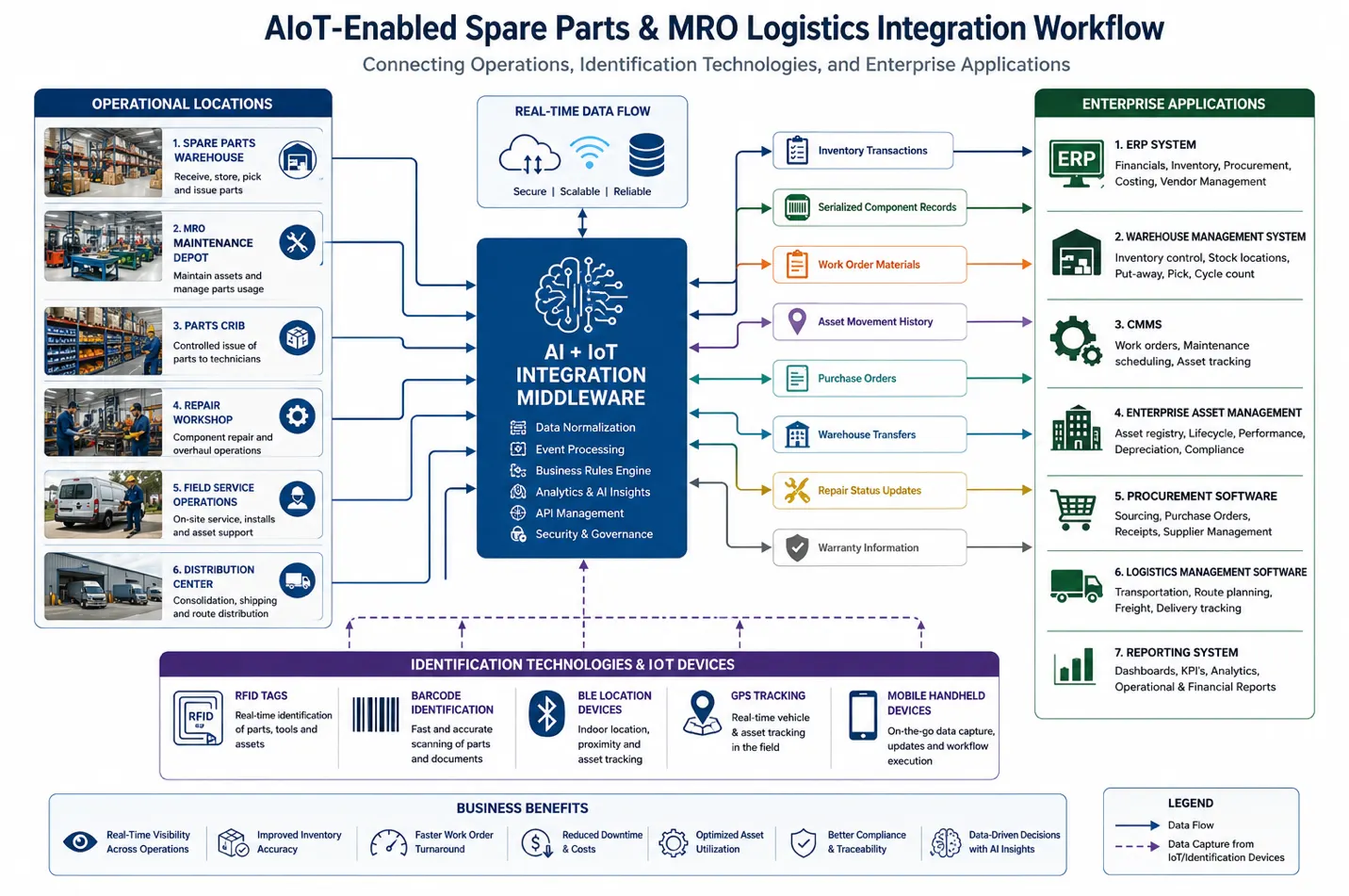
This enterprise workflow diagram illustrates how AIoT integration middleware connects spare parts warehouses, maintenance operations, field service teams, and identification technologies with core enterprise applications. It highlights real-time information exchange for inventory transactions, asset movement, work orders, procurement, warehouse transfers, repair status, and warranty records, enabling end-to-end visibility, automation, and data-driven MRO logistics management.
MRO Middleware and Connectivity
Middleware provides the software connection layer that enables communication between enterprise applications, identification technologies, and operational systems. In Spare Parts & MRO Logistics environments, middleware allows organizations to integrate existing ERP, WMS, CMMS, and EAM applications without requiring replacement of established systems.
A properly designed MRO integration solution manages:
- API communication
- Data transformation
- Enterprise application connectivity
- Event processing
- Transaction validation
- Workflow coordination
- Database synchronization
- System monitoring
- Error handling
Middleware becomes especially valuable for organizations operating multiple facilities with different software applications, legacy systems, or geographically distributed maintenance operations.
By standardizing communication between systems, middleware improves consistency across warehouse operations, maintenance execution, procurement activities, and logistics workflows.
Edge Data Synchronization for Parts Depots
Many organizations operate maintenance warehouses and spare parts depots in remote industrial environments where network availability may vary. Edge-based synchronization enables local operational continuity while maintaining connection with enterprise software systems.
Edge integration supports:
- Spare parts receiving transactions
- RFID-based component identification
- Barcode inventory operations
- Mobile warehouse applications
- Local inventory reconciliation
- Rotable component transfers
- Maintenance material reservations
- Temporary offline transaction storage
When network connectivity becomes available, validated operational information can synchronize with centralized ERP, WMS, CMMS, and EAM systems.
This approach supports remote maintenance facilities, industrial plants, transportation hubs, energy sites, and other locations where uninterrupted spare parts operations are required.
MRO Software Interoperability
MRO organizations commonly operate software from multiple vendors. ERP applications manage procurement and financial processes, WMS solutions control warehouse execution, CMMS systems manage maintenance activities, and EAM systems maintain asset lifecycle records.
Software interoperability enables these applications to exchange information through standardized interfaces.
Examples include:
- CMMS requesting spare parts availability from WMS
- ERP receiving inventory transaction updates
- EAM recording serialized component history
- Procurement systems generating replenishment requests
- Warehouse systems confirming material issues
- Repair systems updating component status
Interoperability reduces disconnected workflows and helps maintenance teams access accurate information when planning repairs and managing inventory.
ERP Connectivity for Spare Parts Systems
ERP integration connects maintenance logistics operations with procurement, supplier management, finance, and enterprise planning processes.
AIoT-enabled ERP connectivity supports:
- Purchase order receiving
- Supplier delivery verification
- Inventory updates
- Material consumption records
- Spare parts purchasing workflows
- Warehouse transfer documentation
- Inventory valuation
- Procurement approvals
- Emergency purchasing processes
By linking operational warehouse events with ERP transactions, organizations improve inventory planning and maintain more accurate enterprise records.
WMS Integration for Warehouse Execution
Warehouse Management System integration connects physical spare parts handling with digital inventory management processes.
MRO warehouses frequently manage:
- Replacement components
- Repairable assemblies
- Consumables
- Maintenance kits
- Calibration equipment
- Emergency stock
- Serialized parts
AI and IoT integration enhances WMS processes through identification and location technologies. Typical WMS integration functions include:
- Automated receiving confirmation
- Storage location validation
- Bin-level inventory updates
- Picking verification
- Parts issue transactions
- Inventory cycle counting
- Shipment confirmation
- Cross-dock coordination
- Warehouse transfer tracking
This improves inventory accuracy and helps maintenance teams locate required components faster.
CMMS and EAM Integration for Maintenance Execution
Maintenance operations depend on accurate coordination between equipment records, work orders, technician activities, and spare parts availability. CMMS and EAM systems provide essential maintenance planning capabilities, but their effectiveness depends on receiving timely information from warehouse and logistics systems.
AI and IoT integration connects CMMS and EAM applications with spare parts identification technologies, inventory systems, and enterprise software to improve maintenance material coordination and asset lifecycle visibility.
CMMS Connectivity for Maintenance Workflows
Computerized Maintenance Management Systems manage preventive maintenance schedules, corrective work orders, technician assignments, maintenance history, and material requirements.
Integration with AI and IoT-enabled spare parts systems allows maintenance teams to access accurate inventory information before executing repairs.
Common CMMS integration functions include:
- Spare parts availability verification
- Work order material reservation
- Technician material requests
- Parts issue confirmation
- Material consumption tracking
- Unused component return processing
- Maintenance completion updates
- Repair cycle status updates
- Emergency maintenance coordination
Connecting CMMS software with warehouse systems reduces maintenance delays caused by unavailable components and improves coordination between planners, technicians, and inventory teams.
Spare Parts Deployment Models
Organizations managing Spare Parts & MRO Logistics require deployment models that align with cybersecurity policies, enterprise IT standards, operational requirements, and facility structures.
MROLog AI supports flexible deployment approaches that allow organizations to integrate AI and IoT software with existing enterprise applications while maintaining operational continuity.
Cloud Software for MRO Logistics
Cloud deployment provides centralized management for organizations operating multiple maintenance warehouses, regional parts depots, and distributed service locations.
Cloud-based AIoT integration software supports:
- Centralized system administration
- Multi-site inventory visibility
- Remote configuration management
- Enterprise reporting
- Standardized workflows
- Simplified software maintenance
- Faster deployment across locations
Cloud deployment is suitable for organizations requiring coordinated visibility across multiple maintenance facilities and warehouse operations.
Server Software for Parts Depots
Private server deployment allows organizations to host integration software within their own IT environments.
This approach supports organizations with specific security, compliance, or infrastructure requirements. Server-based deployment provides control over:
- Application hosting
- Data storage
- Network connectivity
- User authentication
- Backup procedures
- Internal security policies
- Software administration
This model is commonly considered by organizations managing critical infrastructure, regulated manufacturing operations, government-related facilities, and industrial environments with strict data governance requirements.
Hybrid Deployment for Multi-Site Depots
Hybrid deployment combines centralized enterprise management with localized processing capabilities.
This approach supports organizations operating:
- Regional spare parts warehouses
- Remote maintenance facilities
- Manufacturing campuses
- Utility service locations
- Mining maintenance sites
- Transportation maintenance centers
- Contractor-managed inventory locations
Hybrid deployment allows local facilities to continue operational activities while synchronizing important information with enterprise systems.
On-Premises Server Configuration
On-premises deployment enables organizations to operate AI and IoT integration software within existing internal infrastructure.
This configuration supports:
- Direct enterprise network connectivity
- Internal database integration
- Local application control
- Custom security policies
- Existing IT management procedures
- Internal compliance requirements
Selecting the appropriate deployment model depends on operational scale, cybersecurity requirements, software environment, and long-term maintenance objectives.
MRO Workflow Orchestration
Enterprise integration becomes more valuable when connected systems can automatically coordinate business processes. Workflow orchestration enables spare parts warehouses, maintenance teams, procurement departments, and logistics operators to execute processes using synchronized information.
AI and IoT workflow orchestration converts operational events into automated actions across connected software systems.
Automated Parts Workflow Orchestration
Spare parts workflows often involve multiple systems and departments. Automated orchestration reduces manual coordination by connecting warehouse transactions with maintenance and procurement processes.
Examples include:
- Spare parts receiving automatically updating inventory records
- Work order approval initiating material reservation
- Component issue updating maintenance records
- Repair completion updating component status
- Inventory shortages triggering replenishment requests
- Returned parts initiating inspection workflows
- Warranty events updating supplier records
Automated workflows improve process consistency and reduce administrative effort across MRO operations.
Real-Time MRO Data Synchronization
Accurate data synchronization ensures that warehouse teams, maintenance planners, procurement specialists, and logistics managers access consistent operational information.
AIoT integration enables synchronization of:
- Spare parts inventory levels
- Component locations
- Warehouse transactions
- Maintenance requirements
- Work order status
- Shipment information
- Repair progress
- Purchase order updates
- Asset history records
Real-time synchronization improves decision-making for critical maintenance activities where parts availability directly affects equipment uptime.
Cross-System Event Triggering
Event-driven integration enables one operational action to initiate automated processes across connected applications.
Examples include:
- RFID identification of a component updating warehouse records
- Inventory reaching minimum levels generating replenishment requests
- Work order approval reserving required materials
- Shipment confirmation updating logistics records
- Repair completion updating EAM history
- Core return processing updating component lifecycle information
Cross-system event triggering reduces delays caused by manual communication between departments.
Exception Handling Automation
Industrial maintenance environments require rapid response when unexpected issues occur. AIoT integration systems help identify operational exceptions and route them to responsible teams.
Common exceptions include:
- Inventory discrepancies
- Missing components
- Incorrect warehouse transfers
- Failed system synchronization
- Unauthorized inventory movement
- Delayed supplier deliveries
- Material shortages for work orders
- Incorrect component records
Automated exception handling improves operational reliability by helping teams resolve issues before they affect maintenance schedules.
Enterprise Integration Benefits for Spare Parts & MRO Logistics
Integrated AI and IoT systems improve coordination between maintenance, warehouse, procurement, and logistics operations.
Key benefits include:
- Improved spare parts visibility across warehouses
- Faster maintenance material allocation
- Reduced manual inventory reconciliation
- More accurate serialized component records
- Better rotable asset lifecycle tracking
- Improved warehouse execution accuracy
- Faster procurement response
- Enhanced multi-location inventory balancing
- Improved repair cycle visibility
- Stronger audit and compliance support
- More reliable enterprise reporting
Integration also supports future operational expansion. Organizations can add new warehouses, maintenance facilities, software applications, or identification technologies without rebuilding existing processes.
Standardized APIs, middleware services, and workflow automation provide a scalable foundation for evolving MRO logistics environments.
Enterprise AIoT Data Flow and Integration Architecture for Spare Parts & MRO Logistics
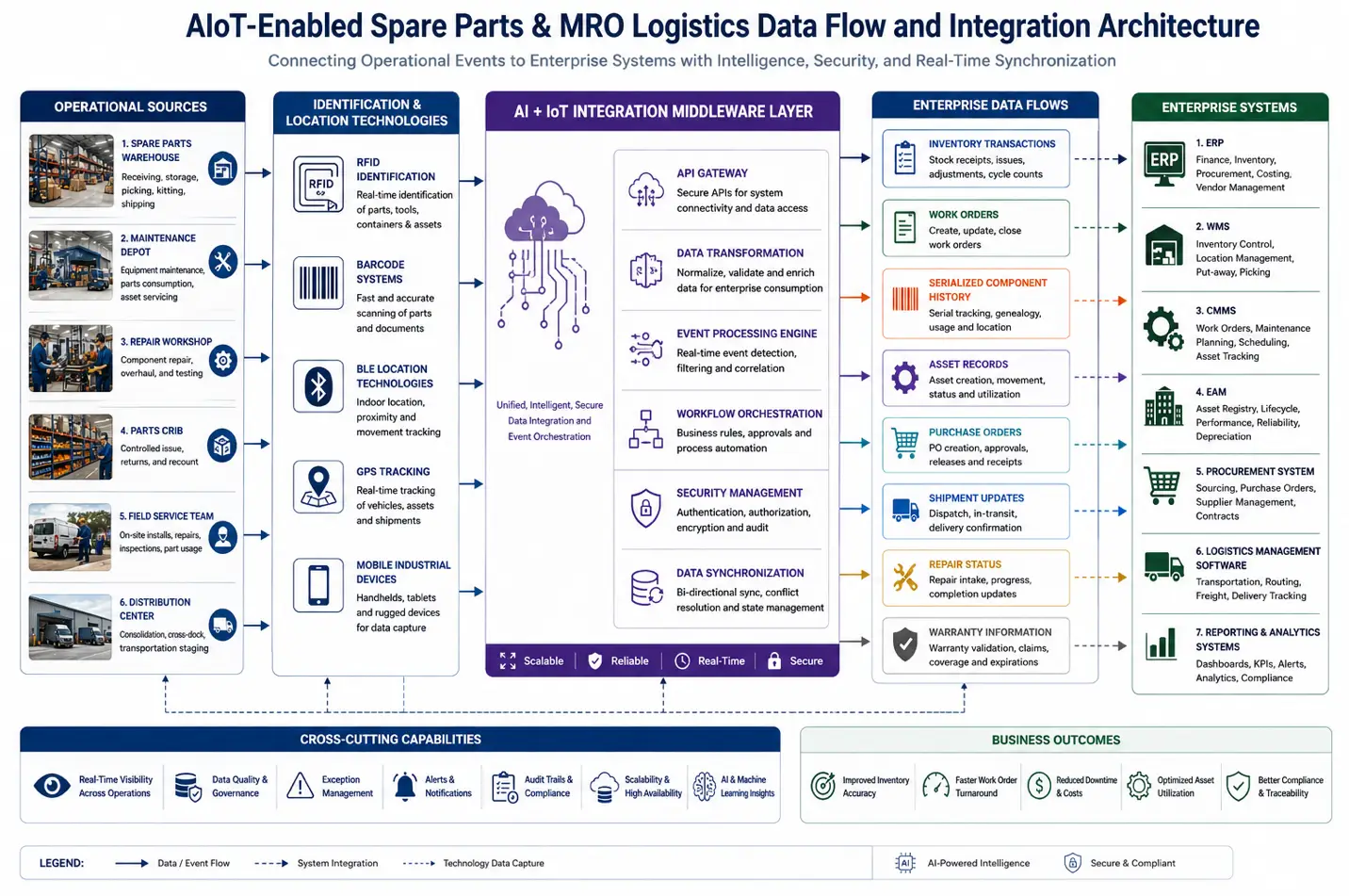
This enterprise architecture diagram illustrates how operational events from spare parts warehouses, maintenance facilities, repair workshops, field service teams, and distribution centers are captured through RFID, barcode, BLE, GPS, and mobile technologies before flowing into an AI + IoT integration middleware layer. The middleware synchronizes and transforms data for ERP, WMS, CMMS, EAM, procurement, logistics, and reporting platforms, providing real-time visibility, automated workflows, improved asset traceability, and enterprise-wide operational intelligence.
API Integration with ERP, WMS, CMMS, and EAM Systems
Enterprise software connectivity is a critical requirement for modern Spare Parts & MRO Logistics operations. Maintenance organizations typically rely on multiple applications to manage purchasing, inventory, maintenance execution, asset records, warehouse activities, and logistics coordination.
AI and IoT integration connects these systems through APIs, middleware services, database interfaces, and secure communication methods. This enables operational information generated from RFID identification, barcode transactions, BLE location systems, GPS tracking, mobile applications, and warehouse activities to flow into enterprise software workflows.
Rather than replacing existing applications, MROLog AI integration solutions extend current ERP, WMS, CMMS, and EAM investments by creating reliable communication between operational systems.
Warehouse Management System Integration
Warehouse Management Systems control daily inventory operations including receiving, storage, picking, replenishment, cycle counting, and shipment execution.
AI and IoT integration enhances WMS capabilities by connecting physical spare parts movement with digital warehouse records.
Common WMS integration functions include:
- Automated receiving confirmation
- Storage location verification
- Bin-level inventory management
- Picking validation
- Material issue tracking
- Inventory transfer processing
- Cycle count reconciliation
- Shipment confirmation
- Cross-dock coordination
- Warehouse transaction auditing
For MRO warehouses managing thousands of components, WMS integration improves inventory accuracy and enables maintenance teams to locate required parts faster.
CMMS Connectivity for Maintenance Operations
CMMS applications coordinate maintenance activities including preventive maintenance schedules, corrective work orders, technician assignments, and maintenance documentation.
Integration between CMMS and AI and IoT-enabled spare parts systems improves coordination between maintenance requirements and material availability.
Common CMMS integration workflows include:
- Work order material planning
- Spare parts reservation
- Technician material requests
- Parts issue confirmation
- Maintenance completion updates
- Component replacement records
- Material consumption tracking
- Returned inventory processing
This connectivity helps maintenance teams avoid delays caused by unavailable spare parts and improves coordination between maintenance planners and warehouse personnel.
EAM Integration for Asset Lifecycle Management
Enterprise Asset Management systems provide long-term visibility into equipment lifecycle, asset history, maintenance strategies, and component relationships.
AI and IoT integration supports EAM systems by connecting physical component identification with digital asset records.
EAM integration applications include:
- Serialized component genealogy tracking
- Asset replacement history
- Rotable component lifecycle management
- Warranty record synchronization
- Repair history updates
- Equipment configuration records
- Component installation tracking
- Asset utilization reporting
Accurate EAM connectivity enables organizations to understand where components are located, where they have been installed, how they have been maintained, and when replacement or refurbishment may be required.
Event Synchronization and Enterprise Data Flow
Spare Parts & MRO Logistics operations generate continuous business events. Each warehouse transaction, maintenance activity, component movement, and logistics action creates information that may need to be shared across multiple enterprise systems.
AIoT integration manages these events through structured data exchange, workflow rules, and automated synchronization.
This allows organizations to maintain consistent information between physical operations and enterprise applications.
Inventory Transaction Synchronization
Inventory accuracy depends on consistent updates across warehouse, maintenance, and enterprise systems.
AI and IoT integration synchronizes:
- Spare parts receipts
- Inventory transfers
- Warehouse movements
- Material issues
- Returns processing
- Stock adjustments
- Serialized component records
- Repairable asset exchanges
- Emergency inventory allocation
For example, when an RFID-identified component moves between storage locations, the transaction can update warehouse records while maintaining visibility within connected maintenance and asset systems.
Maintenance Event Coordination
Maintenance activities require coordination between work orders, inventory availability, equipment records, and logistics processes.
Integrated maintenance event workflows support:
- Work order approval
- Material reservation
- Technician assignment
- Component issue confirmation
- Repair completion
- Equipment return to service
- Asset history updates
- Maintenance documentation
This coordination improves maintenance readiness by ensuring required materials and operational information are available when technicians begin repair activities.
Distribution and Logistics Coordination
Many organizations operate complex spare parts distribution networks involving central warehouses, regional depots, repair facilities, and field maintenance locations.
AIoT integration supports logistics coordination through:
- Inter-warehouse transfers
- Emergency parts dispatch
- Regional inventory balancing
- Cross-dock operations
- Shipment confirmation
- Field service replenishment
- Repair center logistics
- Core return management
- Supplier return coordination
This improves visibility throughout the spare parts supply chain and supports faster response to maintenance requirements.
Security, Identity Management, and Governance
Enterprise integration for Spare Parts & MRO Logistics requires secure communication, controlled access, and reliable operational governance. Maintenance facilities often manage high-value components, serialized assemblies, repairable assets, and critical inventory requiring accurate records and controlled transactions.
MROLog AI integration solutions support secure data exchange through authentication methods, authorization controls, communication security, and operational audit records.
Identity and Access Management
Identity management ensures that employees, contractors, technicians, warehouse personnel, and administrators access only the systems and functions required for their responsibilities.
Integration capabilities include:
- User authentication
- Role-based access control
- Directory service integration
- Multi-factor authentication support
- Contractor access management
- Warehouse permission management
- Administrative approval workflows
Controlled identity management improves accountability and reduces unauthorized system access.
Audit Trails and Operational Records
Accurate audit records are essential for maintenance environments managing serialized components, regulated materials, and critical assets.
AIoT integration maintains operational records including:
- User activity history
- Inventory transaction records
- Component movement history
- API communication logs
- Work order changes
- Software synchronization events
- Warehouse approvals
- Configuration changes
Audit visibility supports compliance requirements, troubleshooting activities, warranty management, and operational reviews.
Enterprise Deployment Best Practices for MRO Integration
Successful AI and IoT integration for Spare Parts & MRO Logistics requires careful planning, structured implementation, and alignment between operational teams and enterprise IT departments. Connecting ERP, WMS, CMMS, EAM, and identification technologies involves more than technical configuration. Organizations must establish reliable data structures, operational workflows, security controls, and long-term governance practices.
A structured deployment approach helps maintenance organizations improve system connectivity while minimizing disruption to warehouse operations and maintenance activities.
Master Data Standardization Before Integration
Accurate master data is essential for reliable communication between enterprise applications. Spare parts environments often contain thousands of components, multiple naming conventions, duplicate records, and different inventory structures across facilities.
Before integration, organizations should standardize:
- Spare part identification numbers
- Serialized component records
- Warehouse location codes
- Bin identifiers
- Equipment references
- Supplier information
- Maintenance material classifications
- Repair status definitions
- Work order categories
- Inventory transaction rules
Consistent master data improves synchronization accuracy between ERP, WMS, CMMS, and EAM systems while reducing reconciliation efforts.
For example, a serialized aircraft component, industrial machine assembly, or utility replacement part should maintain a consistent identity across procurement, warehouse, maintenance, repair, and lifecycle management systems.
Phased AIoT Integration Deployment
Large organizations often operate multiple maintenance warehouses, repair centers, and regional parts distribution locations. A phased deployment approach allows teams to validate workflows before expanding integration across the enterprise.
A typical implementation sequence may include:
- Connecting a central spare parts warehouse
- Integrating ERP procurement processes
- Synchronizing WMS inventory transactions
- Connecting CMMS maintenance workflows
- Linking EAM asset records
- Expanding to regional maintenance facilities
- Adding field service logistics visibility
- Integrating contractor-managed inventory locations
Phased deployment reduces operational risk while allowing organizations to refine workflows based on actual maintenance and warehouse requirements.
AI and IoT Identification Technologies Supporting MRO Integration
Spare Parts & MRO Logistics depends on accurate identification and location visibility of components, inventory, personnel, and mobile assets. AI and IoT technologies enhance enterprise software connectivity by providing reliable operational information that can be integrated into ERP, WMS, CMMS, and EAM workflows.
These technologies support identification, tracking, authorization, and workflow automation across maintenance environments.
RFID Integration for Spare Parts Identification
RFID technology enables automated identification of spare parts, repairable assemblies, containers, and serialized components without requiring direct visual scanning.
RFID integration supports:
- Spare parts receiving
- Automated inventory verification
- Component movement tracking
- Rotable asset management
- Repair cycle visibility
- Warehouse audits
- Shipment validation
- Core return confirmation
- Serialized parts history
For large MRO warehouses managing thousands of components, RFID improves identification speed and inventory accuracy while reducing manual scanning activities.
Barcode Identification Systems for MRO Warehouses
Barcode technology remains widely adopted across maintenance warehouses because of its reliability, low implementation complexity, and compatibility with existing WMS and inventory systems.
Barcode-based workflows support:
- Spare parts receiving
- Material issue transactions
- Bin location verification
- Inventory counting
- Warehouse transfers
- Picking operations
- Shipment preparation
- Maintenance material consumption records
Barcode integration provides organizations with a practical identification method for improving warehouse accuracy.
BLE Identification for MRO Facilities
Bluetooth Low Energy (BLE) technologies support location-aware workflows within warehouses, maintenance facilities, and parts storage areas.
BLE-enabled AI and IoT solutions can support:
- Technician location visibility
- Restricted parts crib access
- Contractor movement records
- Zone-based operational tracking
- Equipment proximity identification
- Maintenance workflow coordination
BLE is particularly useful for indoor environments where organizations require additional visibility into personnel movement and facility activities.
GPS and Cellular Connectivity for Field MRO Logistics
GPS and cellular connectivity extend spare parts visibility beyond fixed facilities by supporting mobile assets, delivery operations, and remote maintenance activities.
Applications include:
- Field service parts tracking
- Mobile inventory visibility
- Emergency component transportation
- Rotable asset movement
- Remote depot connectivity
- Delivery confirmation
- Fleet-based maintenance logistics
These technologies support organizations managing geographically distributed maintenance operations.
LoRaWAN Connectivity for Large Parts Depots
LoRaWAN provides long-range, low-power communication capabilities for large industrial environments where extended coverage is required.
Potential applications include:
- Outdoor spare parts storage areas
- Industrial maintenance yards
- Multi-building warehouse facilities
- Remote inventory locations
- Large equipment staging areas
- Distributed industrial sites
LoRaWAN can complement RFID, BLE, GPS, and cellular technologies depending on operational requirements and facility conditions.
Why Organizations Choose MROLog AI for Spare Parts & MRO Integration
MROLog AI focuses on AI and IoT integration solutions designed specifically for industrial maintenance and spare parts logistics environments.
The solution combines enterprise software connectivity with identification technologies to help organizations improve:
- Spare parts visibility
- Inventory synchronization
- Maintenance workflow coordination
- Serialized component tracking
- Warehouse execution
- Asset lifecycle records
- Multi-site logistics management
MROLog AI was created within Aperture Venture Studio with support from GAO, building upon more than two decades of IoT experience. The company’s foundation includes experience supporting thousands of IoT customers and successfully executing thousands of IoT projects across industrial environments.
The development approach incorporates:
- Significant research and development investment
- Engineering expertise from Ph.D.-level professionals
- Quality assurance processes
- Remote and onsite technical support
- Industrial implementation experience
- Enterprise software integration knowledge
Over the years, the team has supported Fortune 500 companies, leading research and development organizations, universities, and U.S. and Canadian government agencies.
This experience supports practical AIoT integration solutions designed for complex maintenance warehouses, repair facilities, industrial supply networks, and distributed logistics operations
AIoT Integration Powers Smarter Spare Parts & MRO Logistics
AIoT integration provides the digital connectivity foundation required for modern Spare Parts & MRO Logistics operations. By connecting ERP, WMS, CMMS, EAM, warehouse applications, and identification technologies, organizations can improve inventory accuracy, maintenance coordination, component traceability, and logistics execution.
Technologies such as RFID, barcode identification, BLE, GPS, cellular, and LoRaWAN enable accurate identification and location visibility, while middleware, APIs, and workflow orchestration ensure information flows reliably between operational environments and enterprise systems.
MROLog AI helps organizations modernize spare parts and maintenance logistics by integrating existing software investments with AI and IoT capabilities. The result is improved operational coordination, stronger inventory control, and more efficient maintenance support across industrial supply chain environments.
Contact MROLog AI
Organizations managing complex maintenance supply chains require reliable integration between warehouse operations, maintenance systems, and enterprise applications.
MROLog AI helps industrial organizations connect:
- ERP systems
- WMS applications
- CMMS software
- EAM systems
- RFID identification
- Barcode systems
- BLE location technologies
- GPS and cellular tracking
- LoRaWAN connectivity
Through AI and IoT integration, organizations can improve spare parts availability, reduce manual processes, enhance inventory accuracy, and strengthen coordination between maintenance and logistics teams.
Contact MROLog AI to discuss AIoT integration strategies for spare parts warehouses, maintenance depots, repair operations, and industrial logistics networks.
Get in Touch