
Industrial IoT Software for AIoT-Enabled Spare Parts & MRO Logistics Overview
Unlike conventional warehouse software, Industrial IoT software for Spare Parts & MRO Logistics is engineered around maintenance-specific operational workflows. Maintenance inventory continuously moves through receiving docks, inspection stations, quarantine areas, warehouse storage, parts cribs, maintenance staging locations, repair depots, refurbishment facilities, field service vehicles, contractor-managed inventory, and multi-site distribution centers before completing its operational lifecycle.
Every movement must be accurately identified, validated, synchronized, and documented.
Industrial IoT software performs this coordination by collecting identification events generated by connected technologies including RFID, BLE, barcode, GPS, LoRaWAN, handheld warehouse computers, industrial tablets, and fixed identification readers. These events are synchronized with enterprise applications to maintain current inventory records, workforce activity, warehouse transactions, and maintenance documentation.
Within Spare Parts & MRO Logistics, Industrial IoT software commonly manages:
- Enterprise spare parts identification
- Serialized component management
- Rotable asset lifecycle tracking
- Maintenance inventory visibility
- Parts crib operations
- Bench stock management
- Warehouse location management
- Technician mobility
- Contractor inventory accountability
- Mobile warehouse transactions
- Warehouse replenishment workflows
- Inventory synchronization
- Cross-warehouse inventory transfers
- Multi-site distribution coordination
- Service parts logistics
- Core return documentation
- Warranty record association
- Maintenance material issue tracking
- Warehouse audit support
- Repair order logistics
Industrial organizations managing thousands of Stock Keeping Units (SKUs), serialized maintenance assets, and distributed maintenance inventories require software capable of supporting both high transaction volumes and strict inventory governance. Industrial IoT software provides this operational capability while maintaining interoperability with existing enterprise business systems.
Because maintenance operations frequently span multiple facilities, warehouses, and field locations, synchronized operational information becomes essential for minimizing equipment downtime and improving maintenance responsiveness. Connected Industrial IoT software ensures maintenance planners, warehouse personnel, procurement teams, and field technicians all work from consistent operational information.
MRO Personnel Tracking Software
Efficient Spare Parts & MRO Logistics depends not only on inventory visibility but also on the coordinated movement of maintenance technicians, warehouse personnel, contractors, field service engineers, and logistics staff. Maintenance organizations frequently operate across multiple warehouses, parts cribs, repair centers, production facilities, and remote service locations, making workforce coordination an important operational requirement.
Industrial IoT software provides personnel tracking capabilities that focus on workforce location, authorized facility access, warehouse mobility, technician accountability, labor utilization, and operational coordination. Unlike conventional workforce management applications, MRO personnel tracking software is specifically designed to support maintenance logistics workflows where employees regularly interact with serialized assets, controlled inventory, repairable components, calibration equipment, contractor-issued tools, and restricted maintenance areas.
Using identification technologies such as RFID employee badges, BLE credentials, barcode identification, mobile workforce applications, and connected access control systems, Industrial IoT software continuously records authorized workforce activities without interrupting maintenance operations.
Common operational capabilities include:
- Real-time technician location visibility
- Maintenance crew assignment tracking
- Warehouse labor distribution analysis
- Parts crib personnel management
- Contractor workforce accountability
- Technician credential validation
- Authorized maintenance area access
- Shift transition coordination
- Mobile workforce activity logging
- Multi-site workforce visibility
- Emergency personnel accountability
- Operational labor history reporting
These capabilities help maintenance supervisors improve workforce coordination while supporting warehouse productivity, maintenance scheduling, operational compliance, and overall logistics efficiency.
Industrial IoT Workflow for Spare Parts & MRO Logistics, Warehouse Operations, and Enterprise Maintenance Management
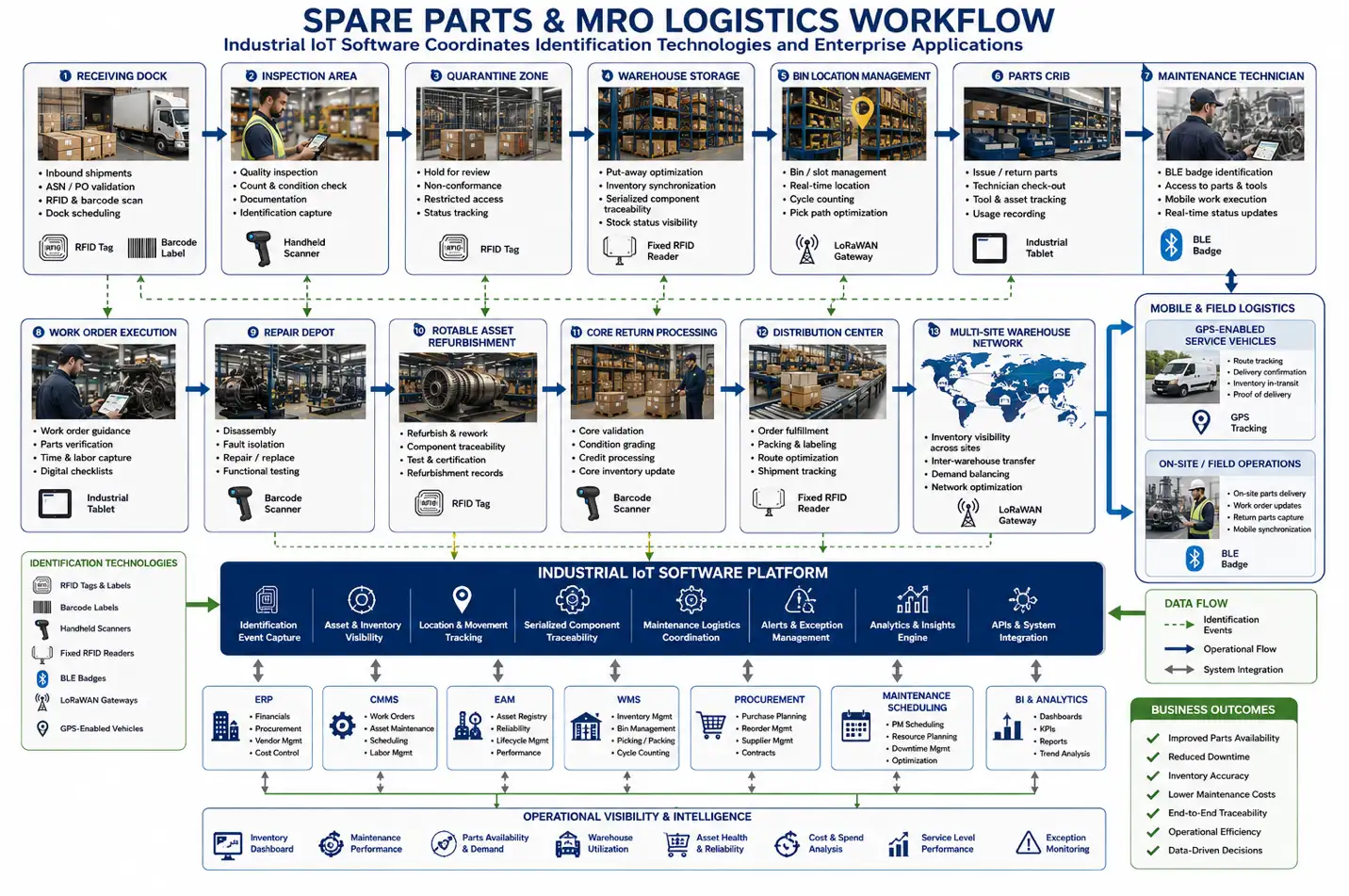
This enterprise workflow diagram illustrates the complete Spare Parts & MRO Logistics lifecycle, from receiving, inspection, quarantine, warehouse storage, and bin management through work order execution, repair depots, rotable asset refurbishment, core return processing, distribution centers, and multi-site warehouse networks. It demonstrates how Industrial IoT software integrates RFID, barcode, BLE, GPS, and LoRaWAN identification technologies with ERP, CMMS, EAM, WMS, procurement, and maintenance scheduling systems to improve asset visibility, serialized component traceability, inventory synchronization, warehouse mobility, maintenance coordination, and enterprise operational intelligence.
Maintenance Crew Location Software
Maintenance technicians routinely move between warehouse aisles, maintenance staging areas, production equipment, repair workshops, inspection locations, contractor workspaces, and field service vehicles throughout each shift.
Maintenance Crew Location Software captures authorized identification events from connected Industrial IoT devices to provide supervisors with accurate workforce visibility across the maintenance operation. Rather than manually recording workforce movement, maintenance managers gain access to continuously updated operational information supporting dispatch coordination, technician availability, warehouse staffing, and emergency response.
Typical deployment objectives include:
- Improving maintenance dispatch efficiency
- Reducing technician search time
- Optimizing warehouse labor allocation
- Supporting emergency accountability procedures
- Coordinating preventive maintenance activities
- Balancing technician workloads across multiple maintenance facilities
- Improving repair turnaround coordination
- Enhancing workforce utilization reporting
For organizations operating geographically distributed maintenance networks, this software provides a unified operational view of workforce activities across multiple warehouses, depots, and service locations, improving responsiveness and supporting more efficient Spare Parts & MRO Logistics operations.
Spare Parts Tracking Software
Industrial Spare Parts & MRO Logistics depends on maintaining continuous visibility of maintenance materials, repairable assets, critical spares, rotable assemblies, service kits, calibration equipment, and high-value replacement components throughout their operational lifecycle. Every warehouse transaction must accurately identify where an item is located, who is responsible for it, its current operational status, and whether it is immediately available for planned or emergency maintenance activities.
Industrial IoT software provides the operational software layer that transforms individual identification events into a continuously synchronized inventory record. Rather than relying on manual inventory updates, paper-based issue records, or periodic reconciliation, the software automatically captures authorized RFID reads, barcode scans, BLE identification events, GPS location updates, and mobile warehouse transactions to maintain accurate enterprise-wide inventory visibility.
Within Spare Parts & MRO Logistics, this software coordinates inventory movement across receiving docks, maintenance stores, parts cribs, distribution centers, repair depots, refurbishment facilities, contractor-managed inventory locations, field service vehicles, and multi-site warehouse networks. Every approved transaction becomes part of a trusted operational record supporting maintenance planning, warehouse execution, procurement, and enterprise logistics.
Industrial IoT software integrates with ERP, CMMS, EAM, WMS, procurement, warehouse mobility, and maintenance scheduling software to eliminate isolated inventory records and improve operational consistency across the Industrial Logistics & Supply Chain.
Typical software capabilities include:
- Enterprise spare parts visibility
- Serialized component identification
- Rotable asset location management
- Warehouse location verification
- Maintenance inventory synchronization
- Parts crib transaction management
- Mobile warehouse operations
- Warehouse receiving and put-away
- Picking and issuing verification
- Inter-warehouse inventory transfers
- Cross-dock logistics coordination
- Contractor inventory accountability
- Repair order inventory support
- Core return management
- Distribution center visibility
- Multi-site warehouse synchronization
Organizations benefit from higher inventory accuracy, reduced maintenance delays, faster warehouse operations, improved asset utilization, and stronger inventory governance while minimizing manual data entry.
MRO Asset Visibility Software
Maintenance organizations invest significant capital in repairable assets that repeatedly circulate between production equipment, maintenance workshops, external repair vendors, warehouse storage, refurbishment facilities, and inspection laboratories. Maintaining accurate visibility of these assets directly affects maintenance planning, equipment availability, and inventory investment.
MRO Asset Visibility Software continuously records verified identification events throughout each movement stage, allowing maintenance planners, warehouse personnel, and logistics coordinators to locate assets quickly and confidently.
Typical assets managed include:
- Rotable components
- Electric motors
- Gearboxes
- Pumps
- Compressors
- Hydraulic cylinders
- Hydraulic power units
- Industrial valves
- PLC modules
- Variable frequency drives
- Instrumentation assemblies
- Control cabinets
- Maintenance tooling
- Calibration equipment
- Test equipment
- Mobile maintenance assets
Each asset maintains a continuously updated operational history documenting warehouse movements, equipment installations, maintenance activities, refurbishment cycles, inspections, and storage locations.
This visibility reduces unnecessary replacement purchases, minimizes search time, improves repair planning, and supports long-term lifecycle management.
Service Parts Movement Software
Maintenance inventory rarely remains within a single storage location. Service parts routinely move between receiving docks, inspection stations, warehouse shelves, quarantine areas, parts cribs, production maintenance teams, repair workshops, contractor facilities, distribution centers, field service vehicles, and customer operating sites.
Service Parts Movement Software records every authorized inventory movement using Industrial IoT identification technologies. Each transaction updates enterprise inventory records while maintaining complete movement history for operational reporting, maintenance planning, and compliance documentation.
The software commonly manages:
- Receiving confirmation
- Warehouse put-away
- Internal warehouse transfers
- Parts picking
- Technician issue transactions
- Maintenance returns
- Cross-dock transfers
- Depot-to-depot transfers
- Emergency shipment coordination
- Distribution center staging
- Field service inventory movement
- Contractor inventory issue
- Vendor return processing
- Repair depot receipt
- Refurbishment transfer
- Final warehouse return
Maintenance organizations gain continuous visibility into where every service part is located throughout the logistics process, improving maintenance responsiveness while reducing unnecessary warehouse handling.
Rotable Component Tracking Software
Rotable assets represent some of the most valuable inventory within Spare Parts & MRO Logistics. Unlike consumable inventory, these components remain in service for many years while repeatedly moving through installation, removal, repair, refurbishment, testing, recertification, storage, and redeployment.
Rotable Component Tracking Software manages each serialized asset individually throughout its complete operational lifecycle.
Typical lifecycle events include:
- Warehouse issue
- Equipment installation
- Operational deployment
- Scheduled removal
- Maintenance inspection
- External repair
- Internal refurbishment
- Functional testing
- Certification approval
- Warehouse return
- Inventory availability update
- Asset retirement
Each event contributes to a complete lifecycle history supporting:
- Reliability engineering
- Maintenance planning
- Asset utilization analysis
- Warranty administration
- Capital asset management
- Regulatory documentation
- Repair history analysis
- Component replacement planning
Complete serialized visibility improves decision-making while extending asset life and reducing unnecessary capital expenditure.
Cross-Dock Parts Visibility Software
Industrial organizations operating regional distribution centers frequently move maintenance inventory directly from inbound shipments to outbound transportation without prolonged warehouse storage.
Cross-Dock Parts Visibility Software coordinates identification events occurring during receiving, sorting, routing, staging, loading, and shipment verification.
Industrial IoT software enables warehouse teams to monitor:
- Shipment arrival
- Receiving confirmation
- Route assignment
- Outbound staging
- Carrier verification
- Transfer confirmation
- Distribution scheduling
- Warehouse departure
- Delivery confirmation
- Enterprise inventory synchronization
Accurate cross-dock visibility minimizes handling time while improving inventory availability for maintenance teams requiring urgent replacement components.
Organizations supporting geographically distributed maintenance operations particularly benefit from faster inventory movement and more reliable logistics coordination.
MRO Inventory Control Software
Accurate inventory management is fundamental to successful Spare Parts & MRO Logistics. Excess inventory increases carrying costs and warehouse space requirements, while insufficient inventory can delay maintenance work orders, extend equipment downtime, disrupt production schedules, and increase emergency procurement expenses.
Industrial IoT software strengthens inventory governance by synchronizing warehouse identification events with enterprise inventory records in near real time. Instead of depending solely on periodic inventory counts, maintenance organizations continuously maintain accurate inventory status through validated operational transactions captured during receiving, storage, picking, issuing, transfers, repairs, and returns.
The software supports inventory control across:
- Critical spare parts
- Insurance spares
- Repair kits
- Bench stock
- Consumable inventory
- Rotable assets
- Capital spare equipment
- Vendor-managed inventory
- Contractor-managed inventory
- Emergency maintenance inventory
- Remote maintenance depots
- Regional distribution centers
- Central warehouse operations
- Multi-site enterprise inventories
Industrial IoT software also improves collaboration between warehouse operations, procurement teams, maintenance planners, reliability engineers, and production personnel by ensuring that inventory information remains synchronized across connected enterprise systems.
This operational consistency supports better maintenance scheduling, improved warehouse utilization, reduced stock discrepancies, optimized replenishment planning, and more effective enterprise Spare Parts & MRO Logistics management.
Industrial IoT Block Diagram for Enterprise Spare Parts Identification, Tracking, and MRO Logistics
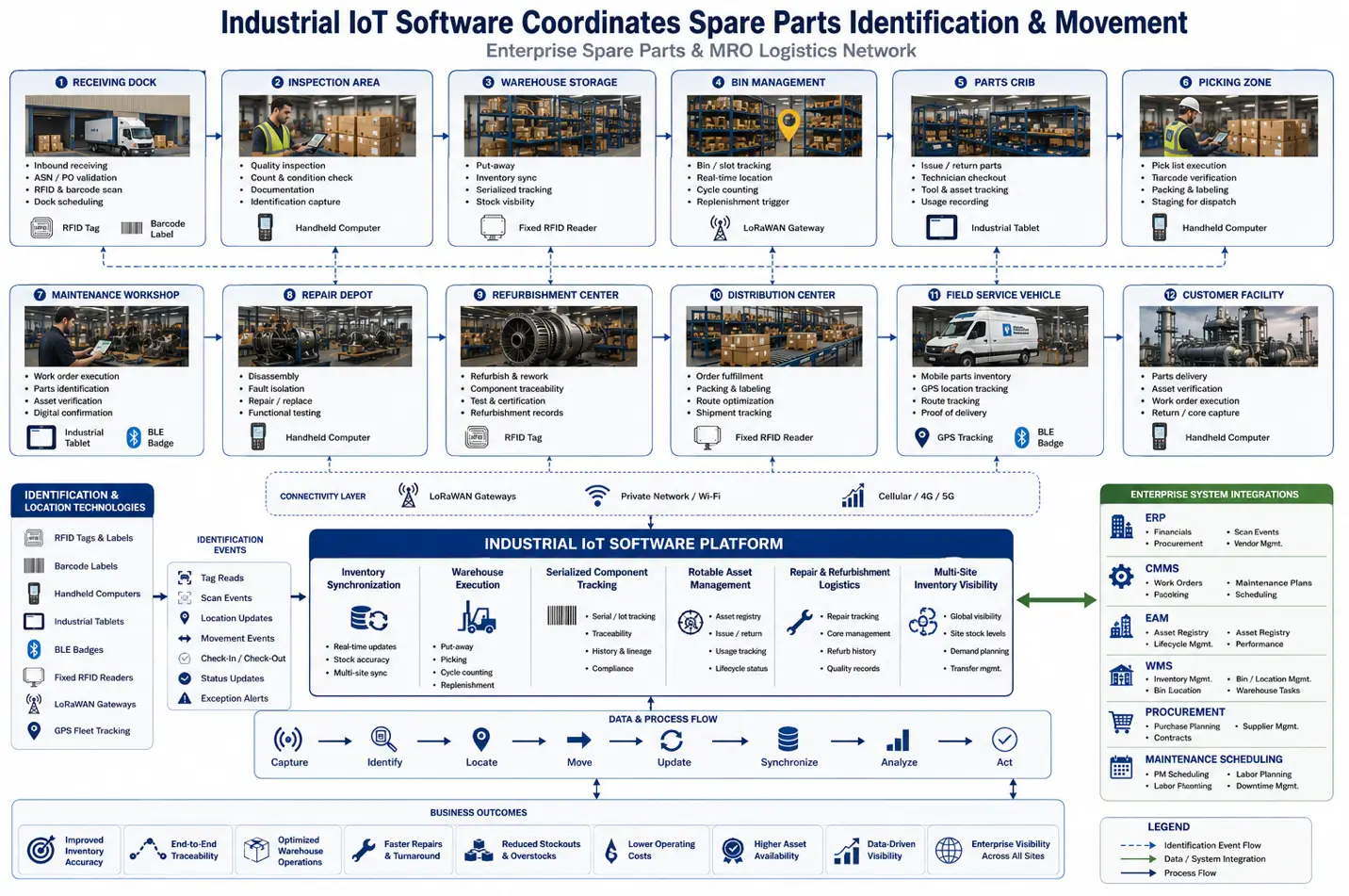
This enterprise block diagram illustrates how Industrial IoT software coordinates spare parts identification and movement across the complete MRO logistics network, from receiving and warehouse operations through maintenance workshops, repair depots, refurbishment centers, field service vehicles, and customer facilities. It demonstrates the integration of RFID, barcode, BLE, GPS, LoRaWAN, handheld mobile devices, and enterprise applications—including ERP, CMMS, EAM, WMS, procurement, and maintenance scheduling—to enable inventory synchronization, serialized component traceability, rotable asset management, warehouse execution, repair logistics, and enterprise-wide inventory visibility.
Spare Parts Stock Control Software
Effective stock control requires more than monitoring inventory quantities. Warehouse personnel must also understand storage locations, inventory status, reservation requirements, criticality classifications, and planned maintenance demand.
Spare Parts Stock Control Software provides centralized inventory governance while coordinating warehouse transactions with enterprise inventory policies.
Key capabilities include:
- Inventory quantity verification
- Storage location management
- Critical spare classification
- Safety stock monitoring
- Reserved inventory management
- Warehouse availability calculations
- Inventory adjustment documentation
- Material issue authorization
- Warehouse replenishment support
- Inventory audit preparation
- Multi-location inventory balancing
- Historical stock movement analysis
By maintaining accurate inventory records across connected warehouse operations, organizations reduce maintenance delays, improve warehouse productivity, and support more reliable Industrial Logistics & Supply Chain operations.
Parts Bin Management Software
Efficient bin management is fundamental to high-performance Spare Parts & MRO Logistics. Enterprise maintenance warehouses often contain tens of thousands of storage bins distributed across high-bay racking, shelving systems, automated storage areas, secure parts cribs, maintenance stores, kitting locations, staging zones, and satellite warehouses. Even when inventory records are accurate, productivity declines if technicians or warehouse personnel cannot quickly identify the correct storage location.
Parts Bin Management Software maintains a continuously synchronized digital record of every approved storage location. Using RFID, barcode, BLE identification, handheld warehouse computers, industrial tablets, and fixed identification readers, the software validates storage locations during receiving, put-away, replenishment, picking, returns, and warehouse transfers.
Unlike traditional warehouse location software that primarily manages commercial inventory, Industrial IoT software for Spare Parts & MRO Logistics supports maintenance-specific workflows such as repair kits, critical spare storage, bench stock replenishment, warranty inventory segregation, repair staging, quarantine areas, and contractor-managed inventory.
Typical capabilities include:
- Digital bin location management
- Warehouse aisle, rack, shelf, and bin mapping
- Directed put-away validation
- Picking location verification
- Dynamic bin reassignment
- Overflow storage management
- High-value inventory segregation
- Critical spare location management
- Mobile warehouse location updates
- Storage utilization analysis
- Warehouse layout optimization
- Bin occupancy reporting
Accurate bin management significantly reduces technician search time, shortens maintenance response times, improves warehouse productivity, and increases inventory accuracy across large-scale Spare Parts & MRO Logistics operations.
Reorder Point Management Software
Maintenance organizations must balance inventory investment against equipment availability. Overstocking increases carrying costs, warehouse space utilization, and inventory obsolescence, while understocking increases equipment downtime, expedited freight expenses, and emergency purchasing.
Reorder Point Management Software continuously synchronizes inventory movement with enterprise replenishment policies so purchasing decisions reflect current operational conditions rather than delayed inventory reports.
Industrial IoT software improves replenishment planning by providing timely identification events from receiving, warehouse transfers, maintenance issue transactions, contractor inventory usage, repair returns, and multi-site inventory balancing.
Typical software capabilities include:
- Minimum inventory monitoring
- Maximum inventory thresholds
- Safety stock calculations
- Critical spare prioritization
- Automatic replenishment notifications
- Procurement synchronization
- Preferred supplier coordination
- Vendor-managed inventory support
- Seasonal demand adjustment
- Emergency replenishment alerts
- Warehouse exception reporting
- Historical consumption analysis
Organizations supporting manufacturing plants, utilities, mining operations, industrial transportation fleets, petrochemical facilities, and processing plants benefit from more reliable spare parts availability while optimizing working capital and warehouse utilization.
Multi-Warehouse Synchronization Software
Enterprise Spare Parts & MRO Logistics rarely operates from a single location. Maintenance inventory is commonly distributed across central distribution centers, regional warehouses, maintenance depots, contractor-managed parts cribs, field service vehicles, manufacturing plants, utility service centers, mining operations, and remote industrial facilities.
Multi-Warehouse Synchronization Software maintains consistent inventory records by synchronizing approved identification events across connected enterprise systems. Warehouse personnel, maintenance planners, procurement specialists, and logistics managers all work from the same validated operational information regardless of location.
Synchronization activities commonly include:
- Inter-warehouse inventory transfers
- Depot inventory balancing
- Regional warehouse visibility
- Cross-site inventory availability
- Shared critical spare management
- Warehouse transaction synchronization
- Mobile inventory updates
- Distribution center coordination
- Remote depot inventory management
- Enterprise inventory reconciliation
- Contractor inventory synchronization
- Emergency inventory redistribution
This synchronized operational approach enables organizations to reduce duplicate inventory, improve utilization of existing spare parts, accelerate maintenance response, and strengthen enterprise-wide inventory governance.
Aftermarket Parts Traceability Software
Traceability is a core operational requirement within Spare Parts & MRO Logistics because organizations must maintain accurate historical records for serialized components, repairable assemblies, warranty claims, certification documents, regulatory compliance, supplier documentation, and complete maintenance history.
Industrial IoT software establishes digital traceability by associating every approved identification event with the corresponding maintenance component. Warehouse receipts, inventory movements, equipment installations, repair activities, refurbishment cycles, warehouse transfers, inspections, certifications, warranty replacements, and core returns all contribute to a continuously expanding digital lifecycle record.
This historical information supports:
- Maintenance planning
- Reliability engineering
- Regulatory compliance
- Warranty administration
- Supplier quality management
- Asset lifecycle analysis
- Operational auditing
- Inventory governance
- Root cause investigations
- Enterprise reporting
Unlike general inventory history, maintenance traceability emphasizes complete lifecycle documentation for components that repeatedly circulate through operational, repair, refurbishment, and warehouse environments.
Industries benefiting from comprehensive traceability include:
- Industrial manufacturing
- Power generation
- Renewable energy
- Oil and gas
- Mining
- Rail transportation
- Ports and terminals
- Water utilities
- Heavy equipment operations
- Process industries
Comprehensive traceability improves operational confidence while simplifying maintenance documentation and compliance reporting.
Component Genealogy Software
Many maintenance components remain operational for decades while undergoing numerous installation, removal, repair, refurbishment, certification, inspection, and storage cycles.
Component Genealogy Software preserves the complete historical relationship between every serialized component and its operational lifecycle.
Lifecycle records typically include:
- Original manufacturer identification
- Serial number association
- Lot and batch references
- Warehouse receiving history
- Storage location history
- Equipment installation records
- Maintenance removal events
- Repair depot processing
- Refurbishment documentation
- Functional testing
- Certification approvals
- Warehouse return
- Operational redeployment
- Final retirement documentation
Engineering teams use this historical information to improve reliability analysis, optimize replacement planning, evaluate repair effectiveness, and support lifecycle cost management.
MRO Certification Data Software
Industrial maintenance frequently requires documented evidence that repaired or replacement components satisfy manufacturer requirements, organizational procedures, customer specifications, or regulatory obligations.
MRO Certification Data Software securely associates inspection documents, calibration certificates, quality approvals, maintenance releases, refurbishment records, and compliance documentation with the appropriate serialized component.
Typical capabilities include:
- Digital certification management
- Calibration record association
- Inspection history
- Maintenance release documentation
- Quality approval workflows
- Compliance verification
- Electronic document linkage
- Historical certification retention
- Audit-ready reporting
- Controlled document access
Centralizing certification records within Industrial IoT software improves document accessibility while reducing administrative effort during maintenance reviews and operational audits.
Lot and Batch Tracking Software
Although serialized assets receive considerable attention, many maintenance materials are managed using lot or batch identification. Bearings, seals, filters, lubricants, adhesives, electrical consumables, gaskets, fasteners, maintenance chemicals, and repair materials often require complete inventory history throughout warehouse operations.
Lot and Batch Tracking Software records identification events during receiving, warehouse storage, issue, transfer, return, redistribution, and disposal.
The software supports:
- Lot identification history
- Batch movement documentation
- Warehouse inventory segregation
- Distribution verification
- Material issue records
- Warehouse transfer history
- Return processing
- Shelf-life management
- Expiration verification
- Regulatory reporting
Maintaining accurate lot histories improves operational transparency while supporting maintenance investigations, quality assurance activities, and supplier communication.
Warranty Record Management Software
Warranty administration becomes increasingly complex when maintenance organizations manage thousands of serialized repairable assets across geographically distributed operations.
Warranty Record Management Software organizes warranty eligibility using verified operational information generated throughout Spare Parts & MRO Logistics workflows.
Warehouse transactions, repair depot activities, refurbishment events, maintenance installations, replacement history, supplier documentation, and return authorizations become part of a comprehensive warranty record.
Typical software capabilities include:
- Warranty eligibility verification
- Installation history
- Repair history
- Replacement documentation
- Supplier warranty records
- Return Material Authorization (RMA) support
- Core return documentation
- Warranty expiration management
- Supplier performance reporting
- Warranty audit preparation
Accurate warranty records improve cost recovery, strengthen supplier collaboration, and reduce administrative effort while maintaining complete documentation throughout the asset lifecycle.
Enterprise Software Integration for Spare Parts & MRO Logistics
Industrial IoT software is most effective when it operates as an integrated component of the enterprise maintenance environment rather than as an isolated application.
The software exchanges validated operational information with:
- Enterprise Resource Planning (ERP)
- Computerized Maintenance Management Systems (CMMS)
- Enterprise Asset Management (EAM)
- Warehouse Management Systems (WMS)
- Procurement software
- Warehouse mobility applications
- Mobile workforce software
- Maintenance scheduling software
- Inventory planning systems
- Business reporting applications
Typical integration workflows include:
- Spare parts receiving
- Warehouse put-away
- Inventory synchronization
- Maintenance work order support
- Technician issue transactions
- Serialized component history
- Warehouse transfer confirmation
- Procurement replenishment
- Repair order processing
- Distribution center coordination
- Core return management
- Multi-site inventory balancing
This integrated approach creates a single, reliable operational record that supports maintenance planning, warehouse execution, procurement coordination, inventory governance, and enterprise reporting.
MROLog AI was established within Aperture Venture Studio with support from GAO and builds upon more than two decades of Industrial IoT deployment experience. Our engineering teams have supported thousands of Industrial IoT projects serving manufacturing companies, utilities, mining organizations, transportation operators, research institutions, Fortune 500 enterprises, and government agencies. Continuous investment in research and development, rigorous quality assurance, and experienced remote and onsite technical support enables us to deliver reliable Industrial IoT software solutions specifically designed for complex Spare Parts & MRO Logistics environments.
Why Organizations Choose MROLog AI for Spare Parts & MRO Logistics
Selecting Industrial IoT software for Spare Parts & MRO Logistics requires far more than evaluating software features. Enterprise maintenance organizations must ensure that new software integrates with existing maintenance processes, warehouse operations, enterprise applications, and long-term digital transformation initiatives without disrupting daily maintenance activities.
MROLog AI develops Industrial IoT software specifically for Industrial Logistics & Supply Chain organizations managing maintenance inventory, service parts distribution, repairable assets, rotable components, parts crib operations, contractor-managed inventory, and enterprise MRO warehouse networks.
Our engineering approach prioritizes operational reliability, standards-based interoperability, inventory governance, identification accuracy, and long-term maintainability instead of unnecessary software complexity.
Key advantages include:
- Industrial IoT software purpose-built for Spare Parts & MRO Logistics
- Native support for RFID, BLE, barcode, GPS, LoRaWAN, and mobile identification technologies
- Enterprise integration with ERP, CMMS, EAM, WMS, procurement, and warehouse mobility software
- Centralized management of serialized components and rotable assets
- Multi-site inventory synchronization across warehouses and maintenance depots
- Real-time spare parts visibility and warehouse transaction management
- Secure workforce authentication and role-based access management
- Flexible deployment using cloud, on-premises server, or hybrid software models
- Open integration interfaces supporting future system expansion
- Scalable software suitable for single maintenance facilities through global enterprise MRO networks
Every implementation is aligned with operational workflows, warehouse governance, inventory policies, maintenance procedures, and enterprise integration requirements to maximize long-term operational value.
Deployment Considerations
Successful Industrial IoT software implementation begins with understanding maintenance operations, warehouse workflows, and enterprise business processes before selecting identification technologies or software configuration.
Organizations planning Industrial IoT deployment should evaluate:
- Existing ERP, CMMS, EAM, and WMS environments
- Current warehouse operating procedures
- RFID and barcode identification standards
- Serialized component requirements
- Rotable asset lifecycle processes
- Warehouse location structures
- Parts crib operating procedures
- Bench stock management
- Inventory governance policies
- Contractor inventory workflows
- Multi-site warehouse synchronization requirements
- Mobile workforce requirements
- Cybersecurity policies
- User authentication methods
- Network infrastructure readiness
- Disaster recovery planning
- Business continuity requirements
- Long-term software maintenance strategy
- Data governance and retention policies
- Change management and user training
Organizations that standardize inventory identification procedures and warehouse transaction processes before implementation typically achieve faster deployment, higher user adoption, and stronger long-term operational performance.
Supporting Enterprise Maintenance Transformation
Industrial maintenance organizations continue to modernize Spare Parts & MRO Logistics by improving warehouse visibility, inventory governance, workforce mobility, serialized component management, and enterprise software integration.
Industrial IoT software provides the operational software layer that enables maintenance teams to identify, locate, verify, issue, transfer, return, and document spare parts using standardized identification technologies. Combined with AI and IoT capabilities, organizations gain better operational awareness, improved warehouse execution, enhanced inventory planning, and stronger maintenance coordination without disrupting existing maintenance management processes.
By emphasizing identification and location management rather than generic warehouse automation, Industrial IoT software helps organizations achieve measurable improvements in:
- Inventory accuracy
- Warehouse productivity
- Spare parts availability
- Technician efficiency
- Maintenance readiness
- Serialized component governance
- Rotable asset utilization
- Enterprise inventory synchronization
- Maintenance documentation quality
- Multi-site operational coordination
These improvements contribute directly to reduced equipment downtime, improved maintenance performance, lower inventory carrying costs, and greater operational resilience across Industrial Logistics & Supply Chain operations.
Contact MROLog AI
Whether your organization manages a single maintenance warehouse or a global network of spare parts distribution centers, MROLog AI can help develop an Industrial IoT software solution tailored to your Spare Parts & MRO Logistics requirements.
Our technical specialists work closely with maintenance managers, warehouse leaders, reliability engineers, supply chain professionals, IT teams, and system integrators to evaluate existing warehouse operations, enterprise software, identification technologies, and operational objectives before recommending an implementation strategy.
We support deployments across:
- Enterprise spare parts warehouses
- Regional MRO distribution centers
- Maintenance depots
- Parts cribs
- Manufacturing maintenance facilities
- Utility maintenance organizations
- Mining maintenance operations
- Oil and gas maintenance logistics
- Transportation maintenance centers
- Heavy equipment service organizations
- Fleet maintenance operations
- Marine maintenance facilities
- Field service logistics networks
- Multi-site enterprise maintenance organizations
MROLog AI was established within Aperture Venture Studio with support from GAO and reflects more than two decades of Industrial IoT experience. Our leadership includes Ph.D. professionals from leading universities, supported by experienced Industrial IoT engineers, software specialists, and strategic technology partners. Through the broader GAO organization, we have successfully supported thousands of Industrial IoT customers and delivered thousands of projects across Industrial Logistics & Supply Chain environments.
Continuous investment in research and development, rigorous quality assurance processes, and comprehensive remote and onsite technical support enables us to deliver dependable enterprise software for some of the world's most demanding industrial organizations, including Fortune 500 companies, leading research institutions, prestigious universities, and government agencies throughout the United States and Canada.
Whether your objective is improving spare parts visibility, optimizing maintenance inventory, managing serialized components, coordinating multi-site warehouse operations, or strengthening enterprise MRO logistics, our team can help you develop an Industrial IoT software solution aligned with your operational and business goals.
Get in Touch