
Practical AIoT Applications Across Enterprise Spare Parts & MRO Logistics Operations
Spare Parts and Maintenance, Repair, and Overhaul (MRO) logistics operations require precise coordination between inventory teams, maintenance technicians, repair facilities, suppliers, and service locations. Organizations managing industrial equipment, production assets, transportation systems, energy infrastructure, and complex machinery depend on accurate spare parts availability to reduce downtime and maintain operational continuity.
AIoT-enabled Spare Parts & MRO Logistics solutions combine artificial intelligence, IoT identification technologies, connected devices, and industrial software systems to improve visibility across maintenance supply chains. By using technologies such as RFID, BLE, GPS, Cellular IoT, and LoRaWAN, organizations can track spare components, monitor asset movement, optimize inventory workflows, and improve technician coordination.
MROLog AI provides AI and IoT solutions designed specifically for industrial spare parts environments where missing components, inaccurate inventory records, inefficient parts retrieval, and limited visibility into maintenance assets can delay critical operations.
These AIoT applications support:
- Spare parts warehouse visibility and inventory accuracy
- MRO technician location tracking and workflow coordination
- Secure access management for restricted parts storage areas
- Rotable asset lifecycle tracking
- Repair depot workflow optimization
- Multi-site maintenance inventory coordination
- Serialized component traceability
Applications Overview of AIoT for Spare Parts & MRO Logistics
Spare Parts & MRO Logistics requires accurate identification, location visibility, and operational coordination across warehouses, maintenance facilities, repair centers, and field service networks.
Traditional manual processes such as spreadsheet-based inventory management, barcode-only tracking, and periodic stock checks can create operational challenges, including:
- Difficulty locating critical spare components
- Delayed inventory updates after part movement
- Limited visibility into repairable assets
- Unplanned maintenance delays caused by unavailable parts
- Inefficient inventory allocation across multiple locations
AIoT solutions address these challenges by connecting physical spare parts operations with digital identification and location information.
AI and IoT technologies help organizations capture and analyze:
- Spare part location information
- Component movement history
- Technician activity patterns
- Inventory utilization trends
- Repair cycle progress
- Distribution status
The result is improved operational awareness across maintenance warehouses, parts depots, repair facilities, and service networks.
Key Spare Parts & MRO Logistics applications include:
- Spare parts warehouse tracking
- MRO depot repair operations
- Parts distribution center access control
- Field service parts logistics
- Contractor-managed parts crib management
- Multi-site MRO network visibility
- Spare parts traceability analytics
AIoT-Based MRO Facility Access Control Workflow for Secure Spare Parts Management
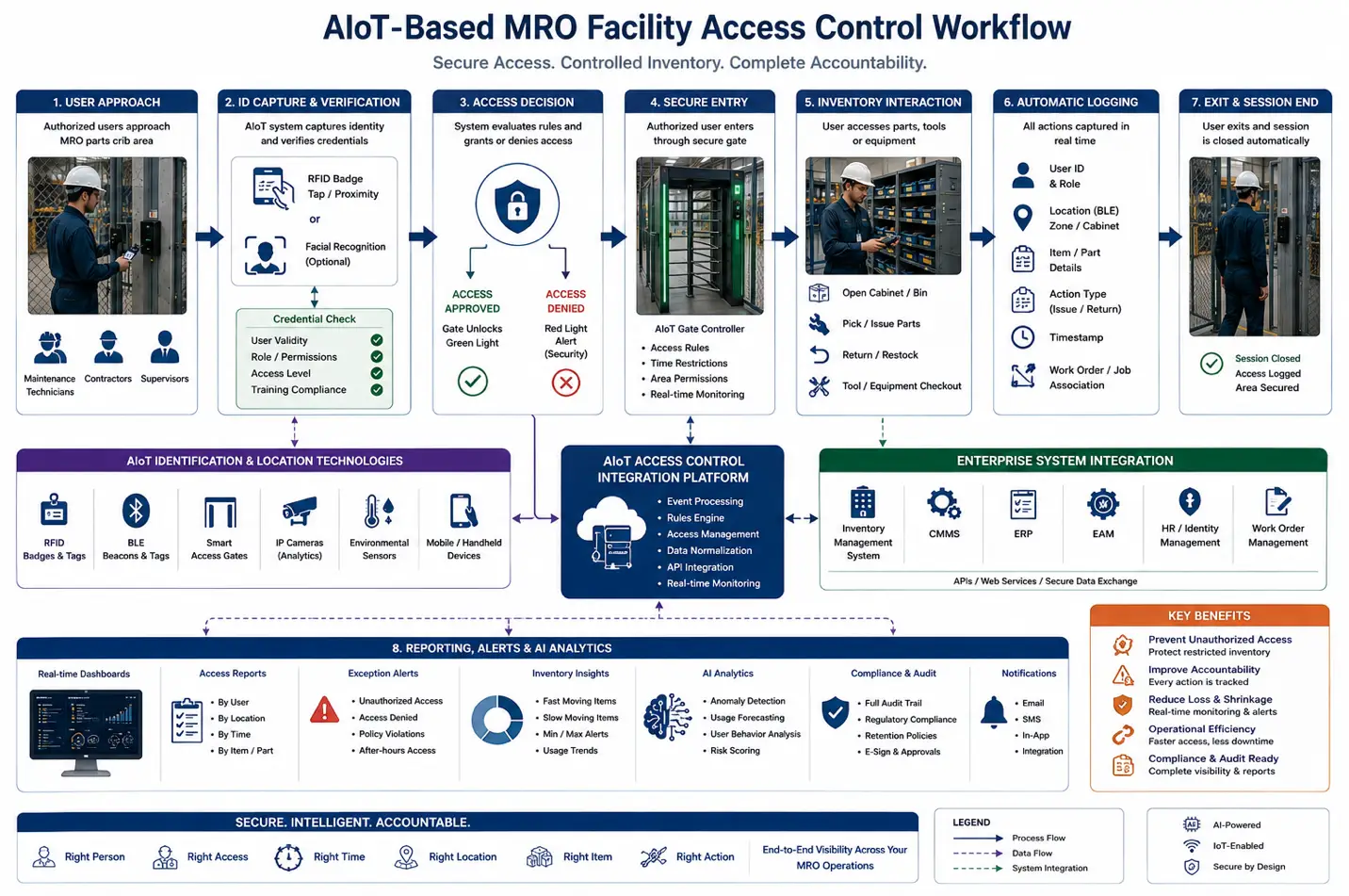
This workflow diagram illustrates how AIoT-enabled access control secures industrial MRO parts cribs by combining RFID badges, BLE location technology, secure access gates, and AI-driven credential verification. It demonstrates the complete process from user authentication and access approval to inventory interaction logging, enterprise system integration, analytics, and compliance reporting, improving inventory security, accountability, and operational efficiency.
AI and IoT Functions Supporting Spare Parts & MRO Logistics
MROLog AI prioritizes AI and IoT capabilities according to their practical importance within enterprise maintenance logistics operations.
The highest-value applications focus on people visibility, secure access control, asset tracking, and inventory optimization because these functions directly affect maintenance response time, parts availability, and operational reliability.
AIoT solutions in Spare Parts & MRO Logistics commonly combine:
- RFID identification for spare component tracking
- BLE location solutions for indoor personnel and asset visibility
- GPS tracking for mobile and rotable assets
- Cellular IoT connectivity for remote operations
- LoRaWAN connectivity for large industrial areas
Maintenance Workforce Location Tracking
Maintenance technicians often work across large industrial facilities containing multiple warehouses, repair areas, equipment zones, and restricted maintenance spaces.
Understanding technician location and movement patterns helps organizations improve task assignment, reduce unnecessary travel time, and coordinate maintenance activities more effectively.
AIoT-enabled workforce location tracking solutions use identification technologies such as BLE badges, RFID credentials, and location-enabled devices to provide operational visibility within MRO environments.
Applications include:
- Real-time MRO technician tracking
- Parts depot labor analytics
- Maintenance crew movement insights
- Technician dwell time analysis
These solutions help maintenance managers understand workforce utilization and improve coordination between technicians, warehouse personnel, and maintenance planners.
For example, when a technician requires a specific replacement component, location visibility can help identify nearby personnel, available parts areas, or workflow bottlenecks that may delay maintenance activities.
Real-Time MRO Technician Tracking
Real-time technician tracking supports large maintenance environments where teams move between parts storage areas, repair stations, production zones, and service locations.
BLE-based location solutions are commonly used for indoor environments because they provide practical visibility within facilities where GPS signals may not be available.
Applications include:
- Technician movement analysis
- Maintenance response coordination
- Workforce allocation improvement
- Facility utilization analysis
AI software can analyze historical movement patterns to identify inefficient workflows and improve maintenance resource planning.
MRO Facility Access Control
Spare parts warehouses and maintenance facilities often contain expensive components, serialized inventory, regulated items, and mission-critical replacement parts.
AIoT-enabled access control solutions improve security by connecting personnel identification with authorized access permissions and location-based activity records.
Applications include:
- Restricted parts crib access
- Automated technician credential verification
- Contractor access verification
- Zone-based entry permissions
These solutions help organizations maintain better control over who can access specific inventory areas while creating accurate digital records of facility activity.
Restricted Parts Crib Access Management
Parts cribs frequently store high-value components, consumables, tools, and maintenance materials required for daily operations.
AI and IoT access solutions support controlled parts crib management by combining:
- RFID employee credentials
- BLE location identification
- Electronic access control systems
- Inventory activity records
This improves accountability by linking authorized personnel access with spare parts handling activities.
Spare Parts Warehouse Tracking
Spare parts warehouses are critical operational areas within MRO logistics networks because they ensure maintenance teams have access to required components when equipment servicing is needed. These facilities may contain thousands of spare parts, serialized components, repairable units, consumables, and specialized maintenance materials.
Maintaining accurate warehouse visibility is challenging when organizations rely on manual inventory checks, disconnected databases, or limited tracking processes. Misplaced components, outdated inventory records, and slow retrieval processes can increase maintenance delays and operational costs.
AIoT-enabled spare parts warehouse tracking improves inventory visibility by combining identification technologies, connected software systems, and AI-based analysis.
These solutions help organizations monitor:
- Spare parts location within warehouses
- Component movement between storage zones
- Inventory availability status
- Part retrieval activities
- Stock utilization patterns
- High-value component handling
AI and IoT warehouse applications support maintenance organizations by creating a more accurate connection between physical spare parts and digital inventory records.
RFID-Based Spare Parts Identification
RFID technology is widely used in MRO warehouses because it enables rapid identification of multiple tagged components without requiring direct line-of-sight scanning.
AI RFID spare parts tracking solutions support:
- Automated receiving verification
- Spare part identification during storage
- Faster inventory reconciliation
- Serialized component tracking
- Parts issue and return verification
For large maintenance warehouses, RFID reduces manual counting effort and improves confidence in inventory records. RFID tags attached to spare components, bins, containers, or repairable assets allow organizations to capture movement events as items enter, leave, or move through designated warehouse areas.
AI RFID MRO Inventory Counting
Inventory accuracy is essential for maintenance readiness. Incorrect inventory information can result in unnecessary purchasing, delayed repairs, emergency part sourcing, or excess stock.
AI RFID inventory counting solutions improve warehouse operations by automating inventory verification activities. Key applications include:
- Automated cycle counting
- Bin-level inventory verification
- Spare parts availability confirmation
- Inventory discrepancy identification
- Stock movement analysis
AI software can analyze inventory usage patterns to support improved replenishment planning and identify slow-moving or frequently required maintenance components.
Spare Parts Bin-Level Visibility
Many MRO operations store thousands of small components across organized bins, cabinets, and shelving systems. Locating individual items quickly is essential for efficient maintenance workflows.
AIoT-enabled bin-level visibility solutions help organizations understand:
- Which parts are available in each storage location
- Which bins require replenishment
- Which components are frequently accessed
- Which inventory locations require optimization
Combining RFID, barcode identification, and location technologies improves warehouse organization and reduces time spent searching for parts.
MRO Depot Repair Operations
MRO depot repair operations involve complex workflows including inspection, diagnosis, repair, testing, refurbishment, storage, and redistribution of maintenance components.
Organizations managing repairable assets require accurate visibility into component status throughout the repair lifecycle. Without reliable tracking, repair teams may experience delays caused by unavailable parts, unclear repair progress, or inefficient component movement.
AIoT-enabled MRO depot repair solutions improve operational visibility by tracking:
- Component movement through repair areas
- Repair workflow status
- Work order progress
- Technician activity
- Parts availability during repair processes
Identification technologies such as RFID and barcode systems connect physical components with digital maintenance records, enabling better coordination between repair teams and inventory managers.
MRO Work Order Progress Analytics
Maintenance repair workflows often involve multiple steps performed by different technicians and departments.
AI-supported work order tracking helps organizations understand:
- Current repair status
- Technician assignment
- Component location
- Pending repair activities
- Completion timelines
By connecting work orders with physical component movement, organizations can identify delays and improve repair turnaround time.
Parts Repair Cycle Optimization
Repairable components require careful lifecycle management because they may move between operational use, inspection, repair, storage, and redeployment stages.
AIoT solutions support parts repair cycle optimization through:
- Component location tracking
- Repair history visibility
- Turnaround time analysis
- Return-to-service tracking
These capabilities are especially valuable for industries managing high-value rotable assets where availability directly affects operational performance.
Rotable Asset Lifecycle Management
Rotable assets are reusable components designed to be removed, repaired, refurbished, and returned to service multiple times.
Examples include:
- Aircraft maintenance components
- Industrial equipment modules
- Automotive manufacturing assemblies
- Heavy machinery replacement units
- Energy equipment components
Managing these assets requires continuous visibility into:
- Current location
- Operational status
- Repair history
- Maintenance records
- Transfer activity between facilities
AIoT-enabled rotable asset management combines identification and location technologies to provide better control over valuable reusable components.
AI GPS Rotable Asset Tracking
GPS tracking is useful for rotable components and maintenance assets that move between geographically separated facilities.
AI GPS solutions support:
- Asset location visibility during transportation
- Shipment status tracking
- Transfer monitoring between depots
- Recovery of misplaced components
GPS combined with Cellular IoT connectivity allows organizations to monitor mobile assets beyond warehouse environments.
Rotable Component History Analytics
Serialized component history is important for maintenance compliance, lifecycle management, and operational planning.
AIoT solutions help maintain records related to:
- Previous installations
- Repair activities
- Inspection events
- Movement history
- Current availability
This information supports maintenance teams when determining whether components are ready for reuse or require additional processing.
Field Service Parts Logistics
Field service maintenance operations depend on delivering the correct replacement components to technicians at the right location and time.
Challenges in field service parts logistics include:
- Limited visibility into mobile spare parts inventory
- Delayed replacement component delivery
- Difficulty tracking returned parts
- Poor coordination between warehouses and technicians
AIoT-enabled field service logistics solutions improve coordination between central warehouses, service vehicles, technicians, and remote maintenance locations.
Applications include:
- Field technician parts visibility
- Service vehicle inventory tracking
- Mobile spare parts management
- Replacement component delivery tracking
- Returnable parts monitoring
AI Cellular Field Parts Monitoring
Cellular IoT connectivity enables organizations to maintain communication with mobile assets and remote service operations.
Applications include:
- Remote inventory visibility
- Mobile parts tracking
- Service route coordination
- Remote depot connectivity
These capabilities help maintenance organizations improve response times and reduce delays caused by unavailable replacement components.
Contractor-Managed Parts Cribs
Many industrial organizations operate contractor-managed parts cribs to support maintenance activities at manufacturing plants, energy facilities, transportation sites, and large industrial locations.
These parts cribs provide technicians with rapid access to frequently required components, tools, and maintenance materials. However, managing contractor-controlled inventory requires strong visibility into authorized access, parts usage, and inventory accountability.
AIoT-enabled contractor-managed parts crib solutions improve control by connecting personnel identification, access records, and spare parts movement information.
Key capabilities include:
- Contractor access verification
- Parts withdrawal tracking
- Authorized user management
- Inventory accountability
- Usage history analysis
- Restricted storage area control
By integrating RFID credentials, BLE location technologies, and inventory software, organizations can associate parts handling activities with authorized personnel and specific operational areas.
AI BLE Parts Crib Access Management
BLE-based identification solutions support indoor visibility within contractor-managed parts cribs and maintenance storage areas.
Applications include:
- Technician presence verification
- Contractor movement logging
- Zone-based access monitoring
- Proximity-based notifications
BLE solutions help maintenance managers understand how personnel interact with storage areas while improving accountability for high-value components.
Automated Parts Withdrawal Verification
Manual parts withdrawal processes can create inventory inaccuracies when components are removed without immediate system updates.
AIoT-enabled withdrawal verification improves inventory accuracy by connecting:
- User identification
- Parts identification
- Storage location information
- Transaction records
This helps organizations maintain reliable records of component usage and improve replenishment decisions.
Multi-Site MRO Network Visibility
Large organizations often operate multiple maintenance warehouses, repair facilities, manufacturing plants, service centers, and regional spare parts depots.
Managing spare parts across multiple locations creates challenges related to inventory distribution, component availability, and maintenance response coordination.
AIoT-enabled multi-site MRO network visibility connects distributed maintenance operations by providing improved insight into:
- Spare parts availability across locations
- Component movement between facilities
- Inventory transfer activities
- Regional maintenance demand
- Critical component allocation
These solutions help organizations reduce unnecessary emergency purchases by identifying available inventory across connected locations.
Multi-Location Spare Parts Visibility
Multi-location inventory visibility helps maintenance planners determine where required components are available before purchasing new inventory.
AI and IoT solutions support:
- Cross-site inventory searches
- Spare parts location verification
- Stock balancing decisions
- Transfer planning between facilities
This improves utilization of existing inventory and reduces excess stock accumulation.
Inventory Demand Forecasting for MRO Operations
AI-based analysis can evaluate historical spare parts usage, maintenance schedules, and inventory movement patterns.
Applications include:
- Service parts demand forecasting
- Slow-moving inventory analysis
- Reorder planning
- Stock availability optimization
By understanding usage patterns, organizations can maintain appropriate inventory levels while reducing unnecessary storage costs.
Spare Parts Traceability Analytics
Traceability is essential for organizations managing serialized components, repairable assets, warranty-controlled parts, and regulated maintenance activities.
AIoT-enabled spare parts traceability solutions create visibility into component history from receiving through operation, repair, return, and retirement.
Key traceability applications include:
- MRO component genealogy tracking
- Serialized parts history analytics
- Warranty compliance verification
- Core return tracking insights
- Certification record management
These capabilities allow organizations to maintain accurate records of component movement and lifecycle events.
MRO Component Genealogy Tracking
Component genealogy provides a complete history of a spare part throughout its lifecycle.
AIoT identification solutions connect physical components with digital records containing information such as:
- Original receipt information
- Installation history
- Maintenance events
- Repair records
- Location changes
- Return status
This is especially important for industries where component history affects safety, compliance, and operational decisions.
Serialized Parts History Analytics
Serialized parts require detailed tracking because each component may have unique maintenance requirements, operating history, and lifecycle conditions.
AIoT solutions support:
- Serial number tracking
- Component movement history
- Maintenance record association
- Repair cycle visibility
By connecting identification records with AI analysis, organizations can improve lifecycle planning and maintenance decision-making.
Core Return Tracking Insights
Core returns are an important part of MRO reverse logistics because repairable components often need to be returned, inspected, refurbished, or exchanged.
AIoT-enabled core return tracking improves visibility into:
- Returned component location
- Return shipment progress
- Exchange status
- Repair readiness
GPS tracking, RFID identification, and connected software improve control over reusable component flows.
IoT Software Solutions for Spare Parts & MRO Logistics
AIoT-enabled MRO operations require software systems capable of connecting identification technologies, location information, inventory workflows, and maintenance processes.
MROLog AI solutions support enterprise spare parts operations through specialized software capabilities designed for industrial maintenance environments.
MRO Personnel Tracking Software
Personnel tracking software improves visibility into technician activities, workforce movement, and facility utilization.
Applications include:
- Maintenance crew location software
- Parts crib badge management software
- Technician shift mapping software
- Contractor movement logging software
These capabilities help organizations coordinate maintenance teams and improve operational efficiency within large facilities.
Spare Parts Tracking Software
Spare parts tracking software connects physical components with digital inventory records.
Applications include:
- MRO asset visibility software
- Service parts movement software
- Rotable component tracking software
- Cross-dock parts visibility software
These solutions improve visibility into component location, movement history, and availability status.
MRO Inventory Control Software
Inventory control software supports accurate stock management across warehouses, depots, and maintenance facilities.
Applications include:
- Spare parts stock control software
- Parts bin monitoring software
- Reorder point management software
- Multi-warehouse synchronization software
AI-based analysis helps identify inventory patterns and improve replenishment decisions.
Hardware Technologies Supporting AIoT-Enabled Spare Parts & MRO Logistics
AIoT-enabled Spare Parts & MRO Logistics operations depend on reliable identification and location technologies that connect physical components with digital systems. Selecting the appropriate hardware depends on factors such as warehouse size, asset value, operating environment, tracking range, and maintenance workflow requirements.
MROLog AI solutions use a combination of RFID, BLE, GPS, Cellular IoT, and LoRaWAN technologies to improve visibility across spare parts warehouses, repair facilities, contractor-managed parts cribs, field operations, and distributed maintenance networks.
These technologies support:
- Accurate spare parts identification
- Real-time asset location visibility
- Improved inventory management
- Better maintenance workflow coordination
- Enhanced traceability of serialized components
AI RFID-Enabled Spare Parts Warehouse Workflow for Intelligent MRO Inventory Management
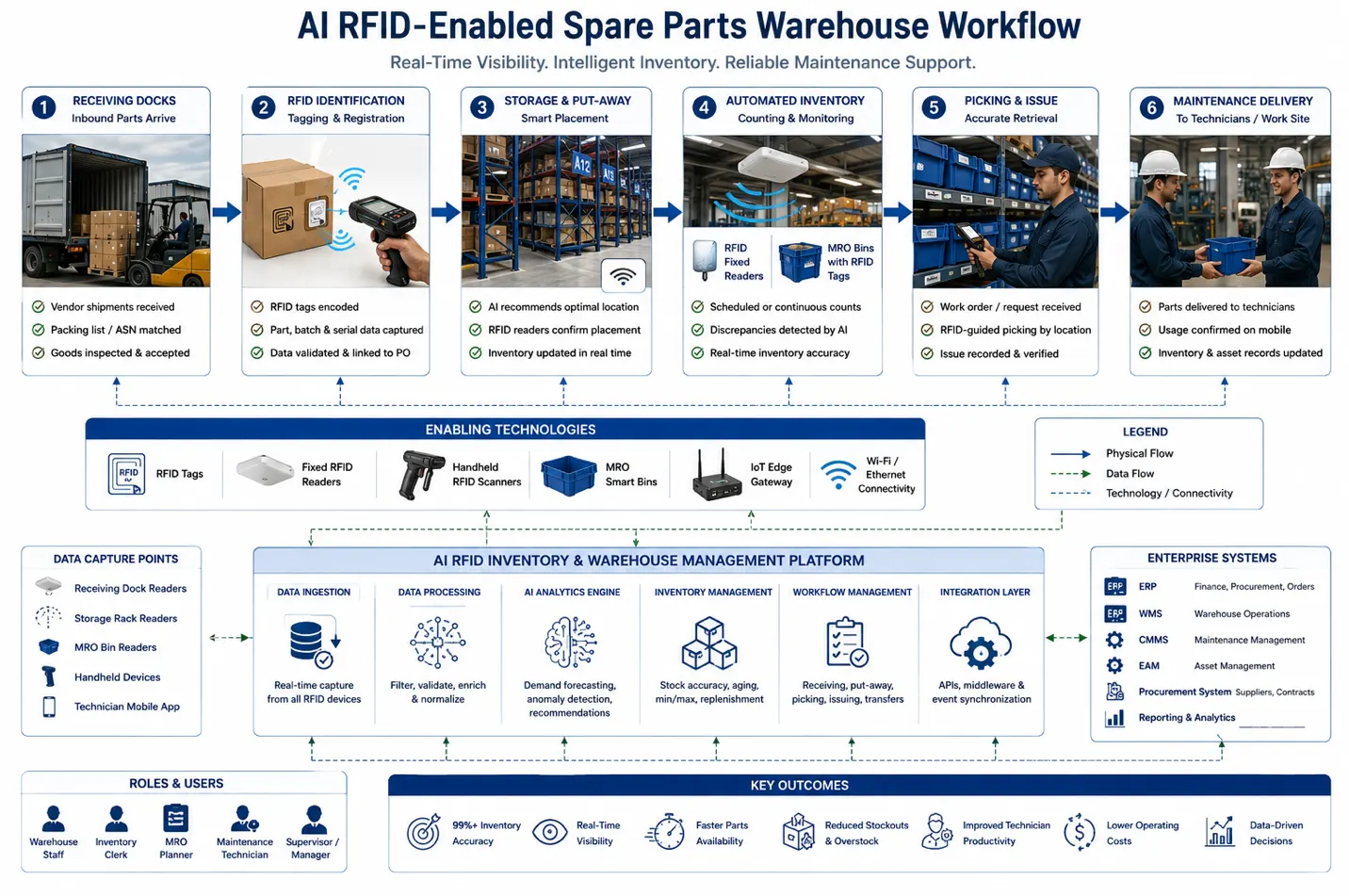
This workflow diagram illustrates how AI and RFID streamline spare parts warehouse operations by automating receiving, identification, storage, inventory counting, order picking, and maintenance delivery. It demonstrates how RFID readers, handheld scanners, AI inventory analytics, and enterprise software work together to improve inventory accuracy, real-time visibility, warehouse efficiency, and spare parts availability for MRO operations.
RFID technology enables automated identification of spare parts, containers, bins, and repairable components throughout MRO operations.
RFID-based solutions are commonly used for:
- Spare parts receiving verification
- Warehouse inventory counting
- Bin-level component identification
- Serialized asset tracking
- Core return verification
Unlike manual identification processes, RFID allows organizations to capture information from multiple tagged items quickly, improving inventory accuracy and reducing manual handling. AI RFID solutions combine RFID identification data with AI software analysis to help organizations understand inventory movement patterns, usage trends, and stock requirements.
Barcode-based identification remains widely used in MRO warehouses because of its simplicity and compatibility with existing inventory processes.
Handheld identification devices support:
- Spare parts picking activities
- Inventory verification
- Receiving operations
- Maintenance issue transactions
- Return processing
Many organizations combine barcode systems with RFID solutions to support different inventory categories and operational requirements.
BLE technology is commonly used for indoor location applications where organizations require visibility into personnel movement, equipment location, and facility activity.
AI BLE solutions support:
- AI BLE technician tracking
- AI BLE parts crib access
- AI BLE proximity alerts
- AI BLE zone occupancy detection
BLE-based identification solutions help organizations understand movement patterns inside warehouses, repair areas, and maintenance facilities.
GPS and Cellular IoT technologies support tracking requirements beyond fixed facilities. These technologies are valuable for rotable asset transportation, field service inventory, remote maintenance locations, and mobile repair equipment.
Applications include:
- AI GPS rotable asset tracking
- AI Cellular field parts monitoring
- AI GPS delivery fleet visibility
- AI Cellular remote depot connectivity
GPS provides location information for mobile assets, while Cellular IoT enables communication from remote locations where traditional network connections may not be available.
Large industrial sites, outdoor storage areas, and remote maintenance locations may require long-range, low-power connectivity.
LoRaWAN-based solutions support:
- AI LoRaWAN parts warehouse tracking
- AI LoRaWAN depot yard visibility
- AI LoRaWAN low-power asset identification
- AI LoRaWAN multi-site coverage
These solutions help organizations extend identification and location capabilities across large industrial areas while supporting distributed MRO operations.
Integration Solutions for Enterprise Spare Parts & MRO Logistics
Enterprise MRO operations typically rely on multiple information systems, including enterprise resource planning (ERP), warehouse management systems (WMS), computerized maintenance management systems (CMMS), enterprise asset management (EAM) software, and inventory control applications.
AIoT integration solutions connect identification technologies with existing enterprise systems to improve workflow coordination and information accuracy.
Key integration capabilities include:
- ERP connectivity for spare parts systems
- WMS integration for warehouse operations
- CMMS and EAM connectivity for maintenance workflows
- Legacy system integration
- Real-time operational data synchronization
MRO Middleware and Connectivity Solutions
Middleware provides communication between AIoT devices, identification systems, enterprise software, and operational databases.
MRO middleware solutions support:
- Edge data synchronization for parts depots
- Device data communication
- Software interoperability
- Workflow event processing
- Automated information exchange
These capabilities allow organizations to enhance existing maintenance systems without replacing established operational processes.
Cloud, Server, Hybrid, and On-Premises Deployment Models
Organizations select deployment approaches based on operational requirements, cybersecurity policies, IT infrastructure, and facility locations.
Common deployment models include:
- Cloud software for centralized MRO logistics management
- Server software for individual parts depots
- Hybrid deployment for multi-site maintenance networks
- On-premises server configuration for controlled environments
Flexible deployment options allow organizations to align AIoT solutions with enterprise technology requirements.
MRO Workflow Orchestration
Workflow orchestration connects spare parts movement, maintenance activities, and inventory processes.
Applications include:
- Automated parts workflow coordination
- Real-time MRO data synchronization
- Cross-system event triggering
- Exception handling automation
For example, when a critical spare component reaches a specific inventory threshold, connected software can trigger replenishment workflows or notify maintenance planners.
Operational Benefits of AIoT-Enabled Spare Parts & MRO Logistics
AIoT solutions improve Spare Parts & MRO Logistics by providing organizations with better visibility into inventory, assets, personnel activity, and maintenance workflows.
Key operational benefits include:
- Improved spare parts availability through accurate inventory visibility
- Faster component retrieval within maintenance warehouses
- Reduced downtime caused by unavailable replacement parts
- Improved control of high-value rotable assets
- Better technician coordination across facilities
- Enhanced access control for restricted parts areas
- Improved serialized component traceability
- More accurate inventory forecasting
- Better coordination between warehouses, repair centers, and field teams
AIoT-enabled identification and location solutions allow organizations to transition from manual tracking processes toward more connected and data-supported maintenance logistics operations.
MROLog AI Experience in AIoT-Based Industrial Logistics Solutions
MROLog AI was created within Aperture Venture Studio with support from GAO, leveraging two decades of IoT experience and thousands of completed IoT projects.
The company develops AI and IoT solutions based on practical industrial requirements from real-world deployments across complex operational environments.
MROLog AI incorporates:
- Extensive IoT implementation experience
- Research and development investments
- Stringent quality assurance processes
- Expert technical support provided remotely and onsite
- Engineering expertise from Ph.D. professionals from leading universities
Through experience supporting Fortune 500 companies, leading research organizations, universities, and government agencies, MROLog AI applies proven IoT practices to improve spare parts visibility, maintenance logistics coordination, and industrial asset management.
Contact MROLog AI for Spare Parts & MRO Logistics AIoT Solutions
Organizations seeking improved spare parts visibility, inventory accuracy, maintenance workflow coordination, and asset tracking can evaluate AIoT solutions designed for their operational requirements.
Contact MROLog AI to explore how AI and IoT identification and location technologies can improve enterprise Spare Parts & MRO Logistics operations.
Get in Touch