
Enterprise AI Software Purpose-Built for Spare Parts & MRO Logistics
Spare Parts & MRO Logistics is one of the most operationally demanding disciplines within Industrial Logistics & Supply Chain because maintenance organizations must consistently deliver the correct service part, repair kit, consumable, or rotable component exactly when equipment maintenance activities require it. Unlike production inventory, maintenance inventory demand is highly variable and is influenced by preventive maintenance schedules, corrective maintenance, emergency repairs, asset condition, equipment criticality, supplier lead times, and unplanned operational events.
Maintenance organizations often manage hundreds of thousands of stock keeping units (SKUs) distributed across central distribution centers, regional spare parts depots, contractor-managed parts cribs, forward stocking locations (FSLs), repair workshops, maintenance warehouses, and field service operations. Maintaining accurate visibility across these geographically distributed inventories is essential for reducing equipment downtime, supporting maintenance service levels, and controlling inventory carrying costs.
MROLog AI provides enterprise AI software specifically developed for Spare Parts & MRO Logistics rather than generic warehouse operations. The software combines Industrial AI, machine learning, predictive analytics, computer vision where operationally appropriate, and AI and IoT identification technologies to transform maintenance logistics data into practical operational recommendations for planners, warehouse supervisors, maintenance managers, inventory controllers, procurement teams, reliability engineers, and field service coordinators.
Rather than replacing existing Enterprise Resource Planning (ERP), Enterprise Asset Management (EAM), Computerized Maintenance Management Systems (CMMS), Warehouse Management Systems (WMS), or maintenance scheduling software, MROLog AI complements these investments by providing advanced operational analytics, predictive recommendations, and enterprise decision support using continuously updated identification and location data collected throughout maintenance logistics workflows.
This maintenance-focused approach helps organizations improve equipment availability, optimize inventory investment, reduce emergency procurement, shorten maintenance cycle times, improve warehouse productivity, and strengthen lifecycle governance for serialized spare parts and repairable assets.
AI Function for AIoT-Enabled Spare Parts & MRO Logistics Overview
Every maintenance transaction generates valuable operational information. Receiving activities, inventory movements, technician assignments, warehouse transfers, parts reservations, work order allocations, rotable exchanges, warranty claims, core returns, repair completions, and inventory adjustments collectively create a rich operational dataset that can be analyzed to improve maintenance logistics performance.
Traditional reporting tools typically summarize historical activity but often provide limited guidance regarding future operational decisions. Enterprise AI software continuously analyzes these maintenance logistics events to identify operational patterns, emerging bottlenecks, inventory risks, and optimization opportunities before they significantly affect maintenance performance.
Examples include:
- Predicting future service parts demand based on preventive maintenance schedules.
- Identifying slow-moving and excess maintenance inventory.
- Forecasting shortages of critical spare parts.
- Optimizing safety stock across multiple warehouse locations.
- Recommending inventory redistribution between maintenance depots.
- Improving warehouse slotting for frequently issued components.
- Identifying underutilized rotable assets.
- Optimizing technician task assignments.
- Prioritizing maintenance work orders according to operational impact.
- Improving inventory replenishment timing.
- Reducing emergency procurement requirements.
- Supporting warranty recovery opportunities through lifecycle analysis.
- Improving core return management.
- Identifying recurring repair cycle bottlenecks.
Rather than replacing maintenance planners and warehouse supervisors, AI software provides continuously updated operational recommendations that support faster and more consistent decision-making across maintenance logistics operations.
Because identification accuracy directly affects analytical accuracy, MROLog AI integrates AI software with enterprise AI and IoT identification technologies including RFID, barcode, BLE, GPS, and LoRaWAN. These technologies provide trusted identification and location events throughout receiving, putaway, warehouse storage, picking, replenishment, transfers, maintenance execution, repair processing, and outbound logistics.
The combination of enterprise AI and reliable identification enables maintenance organizations to reduce manual inventory searches, minimize misplaced components, improve serialized asset governance, shorten maintenance lead times, optimize warehouse labor utilization, and increase spare parts availability throughout the maintenance supply chain.
AI + IoT Enterprise Workflow for Spare Parts & MRO Logistics
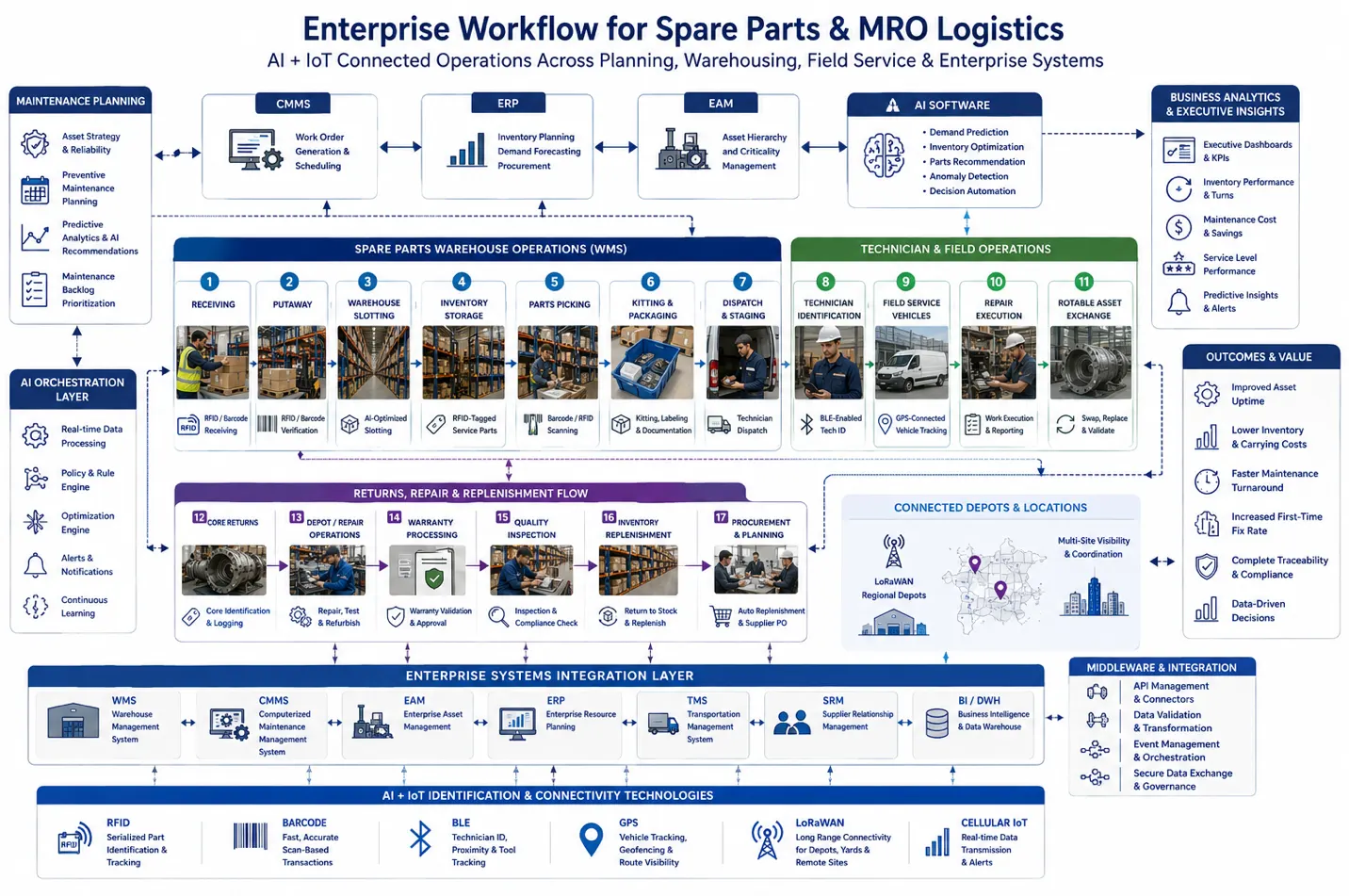
This enterprise workflow diagram illustrates how AI software orchestrates Spare Parts & MRO Logistics across maintenance planning, warehouse operations, technician activities, enterprise systems, and business analytics. RFID, barcode, BLE, GPS, LoRaWAN, and Cellular IoT provide continuous identification, tracking, and asset visibility while AI coordinates inventory planning, work order execution, repair workflows, warranty processing, replenishment, and executive decision-making throughout the maintenance lifecycle.
Why AI Matters for Modern Spare Parts & MRO Logistics
Maintenance inventory management differs fundamentally from production logistics because demand patterns are irregular, service-level expectations are extremely high, and many components have long procurement lead times, limited supplier availability, or strict certification requirements. Organizations must simultaneously balance equipment uptime, maintenance responsiveness, inventory investment, warehouse efficiency, and regulatory compliance.
Conventional inventory planning methods often rely on historical consumption reports, static reorder points, or manual forecasting. Although these approaches remain valuable, they cannot easily account for evolving maintenance schedules, aging assets, equipment modernization programs, seasonal maintenance campaigns, contractor workloads, supplier disruptions, or changing operational priorities across geographically distributed facilities.
Enterprise AI software continuously evaluates thousands of operational variables, including maintenance history, preventive maintenance schedules, equipment criticality, supplier lead times, ABC inventory classifications, safety stock policies, warehouse throughput, repair turnaround performance, inventory turnover, and multi-echelon inventory availability. The resulting recommendations enable organizations to improve service part availability while reducing unnecessary inventory investment and warehouse operating costs.
Maintenance organizations also benefit from greater operational consistency because recommendations are generated from continuously updated enterprise data rather than isolated spreadsheets or periodic manual reviews. This supports more informed inventory planning, warehouse operations, maintenance scheduling, procurement decisions, and lifecycle management across complex industrial maintenance networks.
Built for Enterprise Maintenance Logistics
MROLog AI has been developed specifically for organizations operating complex Spare Parts & MRO Logistics networks across manufacturing, mining, utilities, transportation, energy, heavy industry, and other asset-intensive sectors. The software reflects practical implementation experience gained through thousands of industrial IoT deployments supporting maintenance operations, warehouse logistics, asset management, and enterprise supply chain modernization.
Developed within Aperture Venture Studio with support from GAO, MROLog AI builds upon more than two decades of industrial IoT expertise. Significant investments in research and development, enterprise software engineering, quality assurance, and expert implementation services have enabled the delivery of reliable AI and IoT solutions for demanding industrial environments. Supported by Ph.D. professionals, experienced engineers, and enterprise integration specialists, the organization has also contributed to projects serving Fortune 500 companies, leading research organizations, prestigious universities, and government agencies across the United States and Canada.
The following sections examine how enterprise AI software strengthens maintenance workforce coordination, secure access governance, spare parts asset tracking, MRO inventory optimization, repair workflow management, and serialized component traceability to improve operational performance across modern Spare Parts & MRO Logistics operations.
Maintenance Workforce Location Tracking
Maintenance organizations depend on highly coordinated personnel movements across spare parts warehouses, maintenance depots, repair workshops, contractor-managed parts cribs, forward stocking locations (FSLs), staging areas, receiving docks, repair benches, quality inspection stations, outbound shipping areas, and field service operations. Even when the required service parts are available, maintenance delays can occur if technicians spend excessive time locating inventory, waiting for parts issuance, searching for repair tools, or moving between operational zones.
MROLog AI applies enterprise AI software together with AI and IoT identification technologies to improve maintenance workforce coordination without disrupting established maintenance workflows. Rather than functioning as a simple personnel location system, the software transforms secure identification events into operational analytics that help maintenance managers optimize labor utilization, technician productivity, warehouse workflows, and maintenance scheduling.
Personnel identification may be supported using RFID employee badges, BLE identification devices, barcode credentials, secure identity cards, and enterprise access systems. AI software correlates these identification events with maintenance work orders, inventory transactions, warehouse activities, shift schedules, repair priorities, and facility layouts to produce actionable operational insights.
Maintenance supervisors and warehouse managers can analyze:
- Technician travel distances between work areas
- Parts crib visitation frequency
- Warehouse picking efficiency
- Maintenance response times
- Shift labor utilization
- Repair bench occupancy
- Waiting time for parts issuance
- Cross-functional workforce collaboration
- Contractor movement history
- Field service dispatch efficiency
- Warehouse congestion patterns
- Labor distribution across multiple maintenance facilities
Machine learning continuously evaluates historical maintenance activities to identify recurring operational inefficiencies that influence technician productivity. For example, AI software may identify excessive travel between storage zones caused by inefficient warehouse slotting, repeated technician queues at parts counters, or unnecessary movement created by poorly coordinated work order scheduling.
Instead of monitoring individual employees for surveillance purposes, the software focuses on improving operational workflows, workforce planning, warehouse efficiency, and maintenance execution while supporting organizational governance and privacy requirements.
Operational improvements commonly include:
- Better maintenance workforce scheduling
- Reduced technician travel time
- Improved warehouse labor utilization
- Faster work order execution
- More efficient parts issuance
- Improved technician dispatch
- Better coordination between maintenance planners and warehouse personnel
- Reduced maintenance response times
- Higher maintenance throughput
- Greater workforce productivity across multi-site operations
Organizations operating multiple maintenance depots or regional service centers also benefit from comparative workforce analytics that support standardized operating procedures and continuous operational improvement.
Typical Maintenance Workforce Applications
- Real-time MRO technician location awareness
- Maintenance crew movement analytics
- Technician dwell time analysis
- Shift productivity reporting
- Contractor movement verification
- Maintenance dispatch optimization
- Warehouse labor utilization analysis
- Multi-site workforce coordination
- Parts pickup workflow optimization
- Maintenance response time analytics
- Field service logistics coordination
- Operational workforce performance reporting
MRO Facility Access Control
Maintenance warehouses frequently contain expensive repairable assets, serialized spare parts, aviation-certified components, electrical equipment, hazardous maintenance materials, calibrated instruments, regulated inventory, and warranty-controlled components that require controlled access and comprehensive audit documentation.
Traditional badge access systems verify identity at entry points but typically provide limited operational context regarding work authorization, maintenance assignments, technician qualifications, contractor permissions, or inventory handling responsibilities.
MROLog AI strengthens maintenance access governance by combining secure personnel identification with AI software that evaluates operational context before and after authorized access events occur.
The software integrates enterprise identity management, work order assignments, technician certifications, contractor authorization records, maintenance schedules, and facility security policies to support intelligent access decisions across maintenance operations.
Typical controlled locations include:
- Spare parts cribs
- Serialized component storage rooms
- Rotable asset warehouses
- High-value inventory cages
- Calibration laboratories
- Maintenance workshops
- Tool control rooms
- Warranty-controlled inventory storage
- Contractor staging areas
- Secure maintenance depots
AI software continuously analyzes facility access history to identify unusual movement patterns, repeated authorization failures, unexpected after-hours activity, abnormal warehouse travel sequences, or operational events requiring management review.
Because identification events are correlated with maintenance work orders and inventory transactions, supervisors gain improved visibility into operational accountability while reducing administrative effort associated with compliance reporting.
Organizations operating highly regulated maintenance environments benefit from improved governance through complete electronic audit trails supporting:
- Maintenance compliance
- Contractor accountability
- Inventory protection
- Serialized component handling
- Warranty documentation
- Regulatory inspections
- Internal operational audits
- Enterprise security policies
Rather than replacing existing physical security systems, MROLog AI enhances operational decision support while integrating with enterprise access control infrastructure already deployed throughout maintenance facilities.
Operational Benefits
- Improved maintenance security governance
- Reduced unauthorized inventory handling
- Better contractor access management
- Faster technician authorization
- Comprehensive electronic audit trails
- Improved compliance documentation
- Simplified access administration
- Better warehouse accountability
- Stronger inventory protection
- Improved operational transparency
Spare Parts Asset Tracking
Accurate asset visibility is fundamental to successful Spare Parts & MRO Logistics. Maintenance organizations continuously move service parts, repairable components, rotable assets, maintenance tools, calibration equipment, exchange units, repair kits, inspection devices, and critical spare assemblies between warehouses, repair centers, production facilities, regional depots, contractors, suppliers, and field service locations.
Every unnecessary search for a missing component increases maintenance delays, while duplicate inventory purchases often occur simply because existing assets cannot be located quickly.
MROLog AI combines enterprise AI software with RFID, barcode, BLE, GPS, and LoRaWAN identification technologies to create continuous operational visibility across the complete maintenance asset lifecycle.
Instead of only reporting the latest known asset location, AI software analyzes:
- Asset movement history
- Warehouse transfer frequency
- Rotable utilization rates
- Idle asset duration
- Repair turnaround performance
- Exchange cycle frequency
- Multi-site inventory distribution
- Asset availability trends
- Warehouse dwell times
- Historical maintenance demand
- Asset lifecycle costs
- Inventory velocity
Predictive analytics identifies opportunities to improve operational efficiency by recommending asset redistribution, reducing unnecessary procurement, optimizing warehouse storage strategies, and improving utilization of repairable inventory.
Organizations managing expensive rotable components particularly benefit from lifecycle analytics that evaluate repair frequency, asset availability, refurbishment history, replacement planning, warranty utilization, and long-term ownership costs.
Warehouse managers also gain improved visibility into cross-docking operations, warehouse transfers, forward stocking location replenishment, and depot inventory balancing across geographically distributed maintenance networks.
MRO Inventory Optimization
Maintenance inventory management requires balancing equipment uptime with inventory investment. Unlike production inventory, many maintenance components experience irregular demand, extended procurement lead times, supplier allocation constraints, warranty replacement requirements, and infrequent consumption patterns. These characteristics make traditional inventory planning significantly more challenging.
MROLog AI applies enterprise AI software to continuously evaluate maintenance inventory performance across spare parts warehouses, maintenance depots, forward stocking locations, contractor-managed inventories, and regional distribution centers.
Rather than relying exclusively on static minimum and maximum stock levels, the software evaluates operational variables including:
- Historical service parts consumption
- Preventive maintenance schedules
- Corrective maintenance history
- Equipment criticality
- Supplier lead times
- Procurement performance
- Safety stock policies
- ABC inventory classification
- Multi-echelon inventory availability
- Warehouse replenishment cycles
- Inventory turnover
- Core return processing
- Repair turnaround times
- Seasonal maintenance activities
- Emergency repair frequency
AI software continuously refines inventory recommendations as maintenance requirements evolve, enabling organizations to improve spare parts availability while minimizing excess inventory and reducing obsolete stock.
Inventory optimization also extends beyond individual warehouse locations. Multi-site analytics evaluate inventory distribution across maintenance depots, service centers, manufacturing plants, field service hubs, and centralized warehouses. When appropriate, AI software recommends transferring available inventory between facilities before initiating new procurement activities, improving asset utilization across the enterprise.
Warehouse supervisors additionally receive operational recommendations related to warehouse slotting, picking efficiency, replenishment priorities, cycle counting schedules, inventory accuracy improvement, and warehouse throughput optimization.
The result is a more resilient maintenance supply chain capable of supporting planned maintenance, emergency repairs, shutdown activities, and long-term asset lifecycle management with greater operational efficiency.
Repair and Work Order Tracking
Efficient Spare Parts & MRO Logistics depends on accurate synchronization between maintenance planning, work order execution, spare parts availability, warehouse operations, technician assignments, and repairable asset management. Even a well-planned maintenance schedule can experience delays when repair kits are unavailable, rotable assets cannot be located, work orders are not prioritized correctly, or warehouse picking activities fail to align with maintenance requirements.
MROLog AI applies enterprise AI software to continuously analyze maintenance work orders together with operational events collected from ERP, CMMS, EAM, WMS, inventory transactions, warehouse activities, and AI and IoT identification technologies. Instead of functioning as a static work order reporting tool, the software provides predictive operational recommendations that help maintenance planners, warehouse supervisors, reliability engineers, and operations managers make better decisions throughout the maintenance lifecycle.
AI software evaluates relationships between:
- Preventive maintenance schedules
- Corrective maintenance activities
- Emergency repair requests
- Technician availability
- Warehouse inventory levels
- Parts reservations
- Rotable asset availability
- Core return processing
- Warehouse picking performance
- Inventory replenishment activities
- Supplier lead times
- Equipment criticality
- Service level requirements
- Historical repair performance
By correlating these operational variables, AI software can identify maintenance bottlenecks before they affect equipment availability. Examples include:
- Work orders delayed by unavailable spare parts
- Repair benches operating above planned capacity
- Repeated shortages of critical maintenance components
- Excessive technician waiting time for inventory issuance
- Delayed rotable exchanges
- Backlogged repair queues
- Inefficient warehouse picking sequences
- Repeated emergency procurement events
- High-frequency maintenance activities requiring revised inventory policies
Historical work order analytics also help organizations identify recurring equipment failures, maintenance process inefficiencies, excessive repair cycle times, and operational practices that increase maintenance costs.
Machine learning continuously improves forecasting accuracy by comparing planned maintenance activities with actual operational outcomes. These insights enable organizations to improve scheduling accuracy, optimize warehouse workflows, reduce maintenance backlog, and increase overall maintenance productivity.
AI-Enabled End-to-End Maintenance Workflow for Work Orders, Inventory, Warehouse Operations, and Enterprise Asset Management
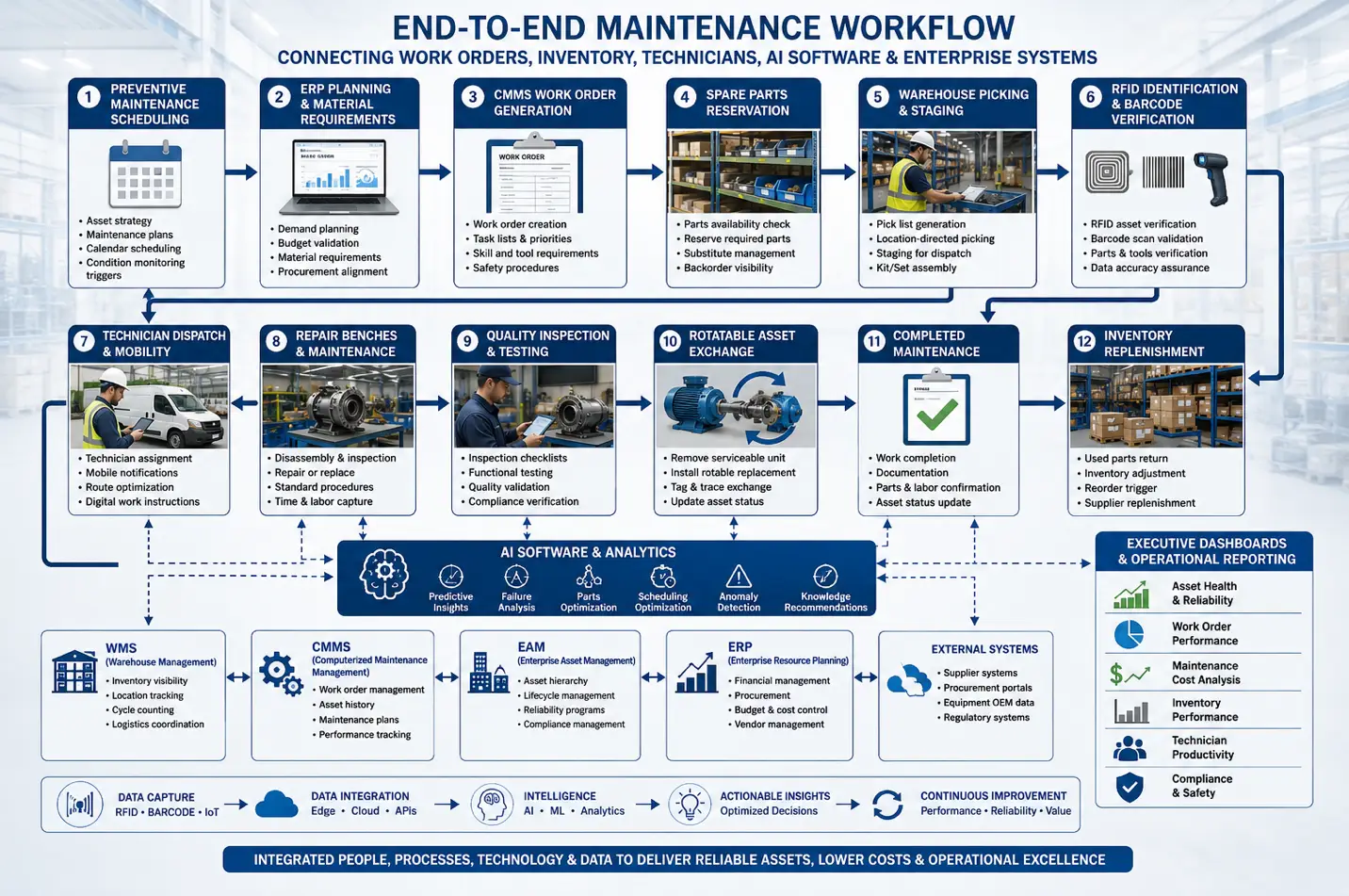
This enterprise workflow diagram illustrates the complete maintenance lifecycle, from preventive maintenance scheduling and ERP planning through CMMS work order generation, warehouse picking, RFID and barcode verification, technician dispatch, repair execution, quality inspection, rotable asset exchange, inventory replenishment, AI-driven analytics, and executive reporting. It demonstrates how integrated enterprise systems improve maintenance efficiency, inventory accuracy, asset reliability, and operational decision-making across industrial maintenance and warehouse environments.
Operational Benefits
- Faster work order completion
- Reduced equipment downtime
- Better maintenance planning accuracy
- Improved warehouse coordination
- Reduced technician waiting time
- Better repair resource utilization
- Improved maintenance service levels
- Lower emergency procurement costs
- Greater maintenance workflow consistency
- Improved operational responsiveness
Spare Parts Traceability Analytics
Complete lifecycle visibility is essential for organizations managing serialized spare parts, repairable assets, regulated maintenance components, and warranty-controlled inventory. Many industrial sectors, including manufacturing, utilities, mining, transportation, aviation, energy, and heavy industry, require comprehensive documentation demonstrating where every critical component originated, how it has been maintained, and where it has been installed throughout its operational life.
MROLog AI provides enterprise AI software that strengthens serialized component governance by combining AI-powered analytics with RFID, barcode, BLE, GPS, and LoRaWAN identification technologies. Every authorized identification event contributes to a continuously expanding digital history that supports maintenance decision-making, lifecycle analysis, and regulatory compliance.
The software maintains relationships between:
- Serialized spare parts
- Rotable assets
- Component genealogy
- Installation history
- Removal history
- Maintenance records
- Repair documentation
- Inspection records
- Warranty information
- Certification documentation
- Core return activities
- Supplier records
- Warehouse movement history
- Asset retirement records
Rather than storing isolated maintenance records, AI software analyzes complete component lifecycles to identify recurring operational issues, warranty recovery opportunities, repeated repair events, supplier quality trends, and asset performance patterns.
Component genealogy becomes particularly valuable when organizations investigate recurring equipment failures, warranty eligibility, supplier performance, or maintenance quality. Maintenance engineers can quickly determine where components have previously been installed, which repairs have been performed, whether certified replacement procedures were followed, and whether similar failures have occurred elsewhere within the enterprise.
AI analytics also improve operational governance by identifying incomplete maintenance documentation, inconsistent serialized records, delayed warranty submissions, missing inspection documentation, or abnormal lifecycle events that require management attention.
Operational Benefits
- Improved warranty recovery
- Stronger serialized asset governance
- Better regulatory compliance
- Faster maintenance investigations
- Complete lifecycle documentation
- Improved supplier performance evaluation
- Better maintenance quality assurance
- Enhanced audit readiness
- Reduced documentation errors
- Improved long-term asset planning
AI and IoT Identification Technologies for Spare Parts & MRO Logistics
Reliable operational analytics begin with accurate identification. MROLog AI integrates enterprise AI software with proven AI and IoT identification technologies that deliver dependable location and identification information across maintenance warehouses, spare parts depots, repair centers, field service operations, and multi-site logistics networks.
Unlike traditional warehouse systems that depend heavily on manual updates, AI and IoT technologies automate the capture of operational events, creating accurate, time-stamped records that support predictive analytics and enterprise decision-making.
RFID for Spare Parts Identification
RFID technology enables rapid identification of spare parts, maintenance kits, storage bins, repairable assets, returnable transport items, and serialized components without requiring direct visual alignment. Automated identification reduces manual data entry, improves inventory accuracy, and accelerates warehouse operations.
Typical RFID applications include:
- Spare parts identification
- Bin-level inventory verification
- Warehouse receiving
- Inventory cycle counting
- Rotable asset management
- Core return verification
- Warehouse picking validation
- Maintenance inventory reconciliation
Barcode Technologies
Barcode systems remain an essential component of many maintenance logistics operations because they provide reliable, cost-effective identification while integrating easily with existing ERP, WMS, CMMS, and EAM software.
Typical applications include:
- Parts receiving
- Inventory putaway
- Warehouse picking
- Maintenance work order verification
- Component identification
- Shipping confirmation
- Inventory audits
- Repair documentation
Bluetooth Low Energy (BLE)
BLE supports personnel identification, mobile asset visibility, operational zone awareness, and maintenance workflow coordination throughout warehouses and maintenance facilities. AI software converts BLE identification events into workforce analytics that improve operational efficiency.
Typical applications include:
- Technician location awareness
- Parts crib access
- Warehouse workforce coordination
- Operational zone occupancy
- Maintenance workflow analysis
- Personnel movement reporting
GPS and Cellular Connectivity
GPS and cellular technologies provide operational visibility across geographically distributed maintenance logistics operations, particularly for field service organizations, mobile maintenance teams, service vehicles, and transportation of repairable assets between maintenance facilities.
Typical applications include:
- Field service logistics
- Service vehicle visibility
- Rotable asset transportation
- Remote maintenance coordination
- Regional depot connectivity
- Mobile maintenance operations
LoRaWAN
LoRaWAN supports reliable long-range communication across extensive industrial maintenance environments, regional spare parts depots, outdoor storage yards, utility facilities, mining operations, and geographically distributed warehouse networks where efficient wide-area coverage is required.
Typical applications include:
- Remote warehouse visibility
- Depot yard asset identification
- Multi-site maintenance logistics
- Long-range inventory tracking
- Distributed warehouse connectivity
- Regional maintenance operations
Enterprise Software Integration and Deployment
Spare Parts & MRO Logistics environments typically depend on multiple enterprise software systems that manage maintenance planning, inventory control, warehouse execution, procurement, asset lifecycle management, and business reporting. Operational value increases significantly when these systems exchange reliable information in real time.
MROLog AI is designed to integrate with enterprise environments through secure middleware and standardized interfaces, enhancing existing business systems rather than replacing them. The software consolidates identification events, maintenance transactions, warehouse activities, inventory movements, and work order information into a unified analytical view that supports enterprise decision-making.
Integration capabilities include:
- ERP integration for procurement and inventory planning
- CMMS synchronization for maintenance work orders
- EAM connectivity for asset lifecycle management
- WMS integration for warehouse execution
- TMS support for maintenance logistics transportation
- Identity and access management integration
- Middleware-based interoperability
- Cross-system event synchronization
- Automated workflow orchestration
- Executive dashboards and operational reporting
To accommodate different operational, cybersecurity, and regulatory requirements, MROLog AI supports multiple deployment models, including cloud software, on-premises server software, hybrid deployments, and multi-site enterprise configurations. These options allow organizations to align AI and IoT capabilities with existing IT policies while maintaining high availability, business continuity, secure data management, and long-term scalability across complex maintenance logistics networks.
Why Organizations Choose MROLog AI for Spare Parts & MRO Logistics
Successful Spare Parts & MRO Logistics depends on much more than maintaining inventory records. Industrial organizations require enterprise software that understands maintenance operations, supports complex warehouse workflows, integrates with established business systems, and provides operational decision support based on accurate identification and location information.
MROLog AI has been purpose-built for organizations managing maintenance warehouses, regional spare parts depots, contractor-managed parts cribs, forward stocking locations (FSLs), repair workshops, rotable asset pools, field service inventories, and multi-site maintenance distribution networks. Rather than offering generic warehouse analytics, the software addresses the unique operational challenges associated with maintenance logistics, including intermittent demand, serialized inventory governance, critical spare availability, warranty compliance, and repair workflow coordination.
The software combines Industrial AI, machine learning, predictive analytics, and AI and IoT identification technologies to strengthen every stage of the maintenance logistics lifecycle while preserving existing investments in ERP, EAM, CMMS, WMS, and enterprise infrastructure.
Organizations select MROLog AI because it supports:
- Maintenance workforce location analytics
- Secure parts crib and warehouse access governance
- Spare parts and rotable asset visibility
- MRO inventory optimization
- Multi-echelon inventory planning
- Service parts demand forecasting
- Warehouse slotting optimization
- Repair workflow coordination
- Serialized component genealogy
- Core return management
- Warranty compliance verification
- Multi-site maintenance logistics visibility
- Enterprise operational reporting
- Predictive maintenance logistics analytics
- Lifecycle cost optimization
This operational focus helps maintenance organizations improve equipment availability, reduce maintenance delays, optimize inventory investment, strengthen warehouse efficiency, and improve long-term asset lifecycle management.
Enterprise Experience Built on Proven Industrial AI and IoT Expertise
MROLog AI was created within Aperture Venture Studio with support from GAO and reflects more than two decades of industrial IoT experience across Industrial Logistics & Supply Chain and other asset-intensive industries. The software has been shaped by practical implementation experience gained through thousands of successful industrial IoT projects supporting maintenance logistics, warehouse modernization, industrial asset management, and enterprise digital transformation initiatives.
Continuous investment in research and development, enterprise software engineering, rigorous quality assurance, and implementation methodologies enables MROLog AI to deliver dependable AI and IoT software suitable for demanding industrial maintenance environments. The organization is supported by Ph.D. professionals from leading universities together with experienced software engineers, industrial consultants, solution specialists, and enterprise integration experts.
Over the years, the broader organization has supported Fortune 500 manufacturers, global industrial enterprises, leading research organizations, prestigious universities, and government agencies throughout the United States and Canada. These real-world implementation experiences have contributed practical engineering knowledge that is reflected throughout the software, deployment methodology, integration strategy, and long-term customer support.
Every implementation is designed to align with existing maintenance operations, enterprise IT governance, cybersecurity policies, operational continuity requirements, and long-term modernization strategies.
Business Benefits for Spare Parts & MRO Logistics Operations
Enterprise AI software creates measurable operational improvements across maintenance planning, warehouse execution, inventory optimization, workforce coordination, and asset lifecycle governance. Rather than optimizing isolated processes, MROLog AI evaluates the complete maintenance logistics operation to support better operational decisions throughout the organization.
Organizations commonly realize improvements including:
- Increased critical spare parts availability
- Reduced maintenance-related equipment downtime
- Higher warehouse inventory accuracy
- Improved technician productivity
- Faster maintenance work order completion
- Reduced emergency procurement
- Lower inventory carrying costs
- Better warehouse space utilization
- Improved warehouse picking efficiency
- Better warehouse slotting strategies
- Reduced excess and obsolete inventory
- Higher rotable asset utilization
- Improved repair turnaround performance
- Better service parts demand forecasting
- Stronger warranty recovery management
- Improved serialized component governance
- Enhanced supplier performance visibility
- Improved multi-site inventory balancing
- Faster inventory reconciliation
- Better maintenance planning accuracy
- Improved operational decision-making
- Greater enterprise-wide maintenance visibility
- Stronger compliance and audit readiness
- More consistent maintenance service levels
- Better long-term asset lifecycle planning
Collectively, these improvements help maintenance organizations maximize equipment availability while reducing total maintenance logistics costs and improving operational resilience across distributed industrial facilities.
Enabling the Next Generation of Spare Parts & MRO Logistics
Modern industrial organizations operate in environments where equipment availability, maintenance responsiveness, inventory accuracy, and supply chain resilience directly influence productivity, safety, and operational profitability. Meeting these expectations requires more than traditional inventory control or historical reporting. It requires intelligent software capable of continuously analyzing maintenance activities, warehouse operations, spare parts movement, workforce coordination, and asset lifecycle information to support faster and more informed operational decisions.
MROLog AI combines Industrial AI with AI and IoT identification technologies to strengthen every stage of the Spare Parts & MRO Logistics lifecycle, including maintenance workforce coordination, secure warehouse access, spare parts identification, rotable asset management, service parts forecasting, inventory optimization, work order execution, serialized component genealogy, warranty compliance, and enterprise-wide operational visibility. By integrating with existing ERP, CMMS, EAM, WMS, and related enterprise software, organizations can enhance current maintenance processes without disrupting established operational workflows.
As maintenance operations continue to become more distributed, data-driven, and performance-focused, enterprise AI software will play an increasingly important role in improving maintenance readiness, reducing equipment downtime, optimizing inventory investment, and supporting long-term asset lifecycle management. MROLog AI provides industrial organizations with a technically robust, enterprise-grade solution that helps transform Spare Parts & MRO Logistics into a more connected, efficient, and intelligent operational capability across the entire Industrial Logistics & Supply Chain sector.
Contact MROLog AI
Whether your organization manages a single maintenance warehouse or a global network of spare parts distribution centers, MROLog AI can help modernize Spare Parts & MRO Logistics through enterprise AI software integrated with AI and IoT identification technologies.
Our technical specialists work closely with maintenance organizations to evaluate warehouse operations, inventory management processes, maintenance workflows, serialized component governance, ERP integration, EAM connectivity, CMMS synchronization, WMS interoperability, cybersecurity requirements, and deployment strategies. Every engagement is based on practical engineering guidance, operational objectives, and measurable business outcomes rather than generic software implementation approaches.
From warehouse modernization and maintenance inventory optimization to rotable asset management, technician location analytics, serialized component traceability, and enterprise integration, MROLog AI provides organizations with the tools required to improve maintenance logistics performance while supporting long-term operational reliability.
Contact MROLog AI to discuss how enterprise AI software can strengthen your Spare Parts & MRO Logistics operations through intelligent maintenance decision support, AI-powered inventory optimization, warehouse analytics, workforce coordination, and enterprise-wide asset visibility.
Get in Touch